The Hidden Language That Kept Me Awake at Night
I remember sitting at my small desk last Tuesday with a thick envelope from my insurance company. My heart was racing as I pulled out forty pages of tiny, cramped text. I tried to read the first page, but it felt like I was looking at a secret code I wasn't allowed to know.
I felt so small and honestly, a bit dumb. I have a job, I pay my bills, but I couldn't tell if my own car was actually covered if a tree fell on it. It felt like the company was trying to hide the truth behind big, scary words.
I spent three hours trying to find one simple answer about my deductible. By the end of it, my eyes hurt and I felt like crying. I realized then that I wasn't the only one feeling this way.
Millions of people pay hundreds of dollars every month for something they don't even understand. We sign these papers because we have to, but we stay in the dark. This lack of clarity ruins our peace of mind and makes us feel unprotected.
When you don't know what the words mean, you always fear the "worst-case scenario." You worry that when you finally need help, the company will point to a tiny word on page thirty-two and say, "Sorry, you aren't covered for that." It’s an emotional weight that no one should have to carry.
I decided that night to stop being a victim of these "fancy" words. I grabbed a highlighter and started searching for a way to break the code. I want to share what I found with you so you never have to feel that same fear and confusion again.
Your Secret Map to Finding Clarity in the Fog
The first thing you need to know is that these documents are not written for you. They are written by lawyers to protect the insurance company. This is why the words feel so heavy and confusing.
If you want to win this game, you have to look at your policy in a new way. Think of it as a treasure hunt where the "treasure" is your own money and safety. You don't need a law degree to understand this stuff; you just need a better plan.
I found that the best way to start is by ignoring the big paragraphs for a moment. Instead, look for the "Declarations Page" at the very beginning. This is like the summary of your entire life with that insurance company.
On this page, you will see your name, your address, and the big numbers. These numbers tell you how much you are paying and the maximum amount the company will pay you. It is the most important part of the whole document.
The Three Pillars of Your Policy
Once you find the summary page, you need to hunt for three specific things. I call these the "Three Pillars" because they hold up your entire financial safety net. If you understand these, the rest of the jargon starts to fall into place.
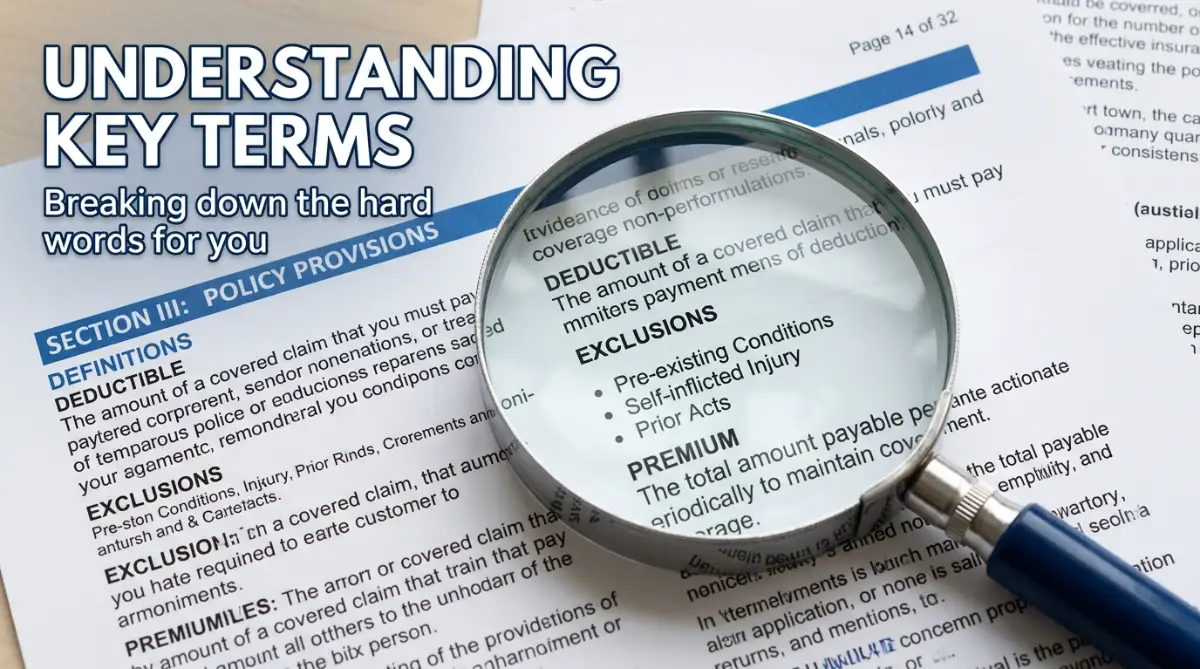
First, find your Premium. This is simply the price you pay to keep the insurance active. I used to think this was the only number that mattered, but I was very wrong.
Second, look for the Deductible. This is the amount of money you have to pay before the insurance company gives you a single dime. If your deductible is $1,000 and the damage is $800, the insurance company pays nothing. I learned this the hard way after a small kitchen fire.
Third, check your Coverage Limits. This is the highest amount the company will ever pay for a single event. If you have a limit of $50,000 for medical bills but the hospital costs $70,000, you are responsible for that extra $20,000. Knowing this number helps you sleep better because you know exactly where your protection ends.
Hunting for the "Exclusions" Trap
This is the part where most people get hurt. Somewhere in the middle of that thick stack of papers is a section called "Exclusions." These are the things the insurance company will not pay for.
I was shocked when I read my home insurance exclusions. It turned out that "water damage" didn't mean all water damage. If a pipe burst, I was fine, but if the street flooded, I was on my own.
You need to read this section very carefully. Use a bright pen and circle every "No" or "Not Covered" you see. It might be scary to see what isn't covered, but it is better to know now than to find out during an emergency.
Pro Tip: I found that keeping a small notebook next to my policy was a lifesaver. Every time I found a word I didn't know, I wrote it down and looked it up later. I realized that "actual cash value" and "replacement cost" are two very different things that change how much money you get back.
The Power of the Definitions Section
Most people skip the section that lists definitions, but that is a big mistake. In an insurance policy, a word like "occurrence" or "family member" might have a very specific meaning. These meanings are often different from how we use them in daily talk.
For example, your policy might define a "resident" in a way that doesn't include your college student living in a dorm. If they get into an accident, the company might say they aren't covered. Reading the definitions helps you see the "fine print" before it becomes a problem.
I spent thirty minutes just reading the definitions in my health insurance papers. I discovered that a "specialist" only counted if I got a note from my main doctor first. That one small detail saved me hundreds of dollars on my next visit.
Understanding these terms is the only way to ensure your family is truly safe. If you want to see how these terms look in a real policy, check out this great video explanation:
How to Handle "Endorsements" and "Riders"
Sometimes, you will see extra pages at the back of your envelope. These are often called Endorsements or Riders. Think of these as "add-ons" to your basic plan.
They can either add more protection or take some away. I once had a rider that added extra coverage for my wedding ring. It was a separate small fee, but it meant the ring was protected even if I lost it at the beach.
If you see these terms, don't ignore them. They often change the rules of the main policy. I always check these first to see if I’m paying for extra things I don’t really need or if I’m missing a gap in my safety.
Spotting the Difference Between "May" and "Shall"
This sounds like a small thing, but in the world of insurance jargon, it is huge. When a policy says the company "may" pay for something, it means they have a choice. It isn't a promise.
If the policy says they "shall" pay, that is a legal requirement. I started looking for these "shall" statements to feel more secure. It helped me understand exactly what the company was legally bound to do for me.
This simple word hunt changed how I viewed my coverage. I stopped feeling like I was asking for a favor and started feeling like I was holding a contract. It gave me my power back.
Why "Grace Periods" are Your Best Friend
Life happens, and sometimes we forget to pay a bill on time. That is where the Grace Period comes in. This is the amount of time you have to pay after the due date before they cancel your policy.
I once missed my car insurance payment by three days because I was sick. I panicked, thinking I was driving without insurance. I checked my documents and found a ten-day grace period.
Knowing this didn't make me lazy about paying, but it did stop my panic. It’s a small bit of "mental breathing room" hidden in the jargon. Make sure you know how long your specific grace period is.
The Reality of "Subrogation"
This is one of those big words that makes people's heads spin. Subrogation is just a fancy way of saying the insurance company can go after the person who caused the accident.
If someone hits your car, your insurance pays you first to get you back on the road. Then, they use "subrogation" to get their money back from the other person's insurance. It’s a behind-the-scenes process that doesn't usually affect you, but it’s good to know why lawyers might be calling.
I used to worry when I saw this word, thinking I was in trouble. Once I understood it, I realized it was just the company doing their own chores. It’s a standard part of almost every policy.
Practical Steps to Organize Your Documents
Don't let your papers sit in a messy pile. I bought a simple blue folder and labeled it "Insurance - Clear & Simple." I put the summary page right at the front.
I also started a "Cheat Sheet" where I translated the hard words into normal English. For example, next to "Liability," I wrote "Money for the other person if I mess up." This made it so much easier for my spouse to understand too.
Having everything in one place reduces the stress of an emergency. You don't want to be hunting for papers while you are standing on the side of the road after a crash. Being organized is the final step in truly decoding your coverage.
By taking these small steps, I turned a nightmare of paperwork into a clear plan. I no longer feel like a stranger to my own insurance. You can do this too, and it starts with just one page at a time.
Stay patient with yourself as you read. It’s okay to look things up and it’s okay to ask questions. Your future self will thank you for the work you are doing today.
Expert Strategies to Stay Ahead of the Insurance Game
Once you understand the basic words, you can start using some pro-level secrets to manage your money better. Most people just buy a policy and forget it. I used to do the same thing until I realized that policies change almost every single year.
The smartest thing you can do is learn to read your Summary of Benefits and Coverage (SBC). This is a short document that explains exactly what you pay for certain services. It uses the same layout for every company, so it is very easy to compare two different plans side by side.
I suggest you spend twenty minutes every few months checking this summary. It helps you remember that you have a $25 co-pay for a doctor visit instead of paying the full price. It also prevents you from being surprised when you get a bill in the mail.
Another secret is to keep a close eye on your Out-of-Pocket Maximum. This is the absolute most you will have to pay in a single year for your covered health services. Once you hit this limit, the insurance company usually pays 100% for everything else. Understanding the truth about your out-of-pocket maximum and hidden costs can save your family from a total financial disaster.
If you have life insurance through your work, you might think you are fully covered. I made this mistake for years until I realized that if I quit my job, that coverage would disappear instantly. It is so important to realize why your job-based life coverage is not enough for your family and why you might need a private plan too.
You should also become a master of the Medical Exam process if you are buying a new policy. Many people get nervous and their blood pressure goes up during the test. This can make your insurance much more expensive. Learning how to prepare for your insurance medical exam without stress is a simple way to keep your premiums low.
Always look for a COLA rider if you are buying long-term coverage. This stands for Cost-of-Living Adjustment. It means your benefits will grow over time to keep up with rising prices. Without this, the money you get in twenty years might not be enough to buy a simple loaf of bread.
I also recommend keeping a digital copy of your policy on your phone. If you are ever in an accident or at the hospital, you don't have to wait until you get home to see your rules. Having that information in your pocket gives you instant power in a stressful situation.
You should also check the AM Best Rating of your insurance company. This is a grade that tells you if the company is financially strong. You can find these ratings on the AM Best website. You want to make sure the company is stable so they can actually pay your claim when the time comes.
Finally, don't be afraid to call and ask for a "Policy Review" with a real person. Tell them you are trying to simplify your coverage. Sometimes they can find small discounts or tell you about a new plan that costs less but offers the same protection.
Heartbreaking Mistakes That Could Cost You Everything
The biggest mistake I ever made was trusting a verbal promise from my insurance agent. He told me over the phone that I was covered for a specific type of damage. When I actually filed a claim, the company pointed to the contract and said "no."
I learned the hard way that why relying solely on verbal promises from agents is extremely risky and can leave you with no help. If it isn't written in the contract, it doesn't exist. Always ask for an email or a letter to confirm anything they tell you on the phone.
Another terrible mistake is under-insuring your home or life. People often pick the cheapest plan to save twenty dollars a month. Then, when a fire happens, they find out their insurance only pays for half the cost to rebuild.
This leads to a lifetime of regret and debt. It is much better to pay a little more now than to lose everything later. Always base your coverage on what it would actually cost to replace your things today, not what you paid for them ten years ago.
Many people also ignore the Grace Period in their contracts. They think if they miss a payment by one day, their insurance is gone forever. While you should always pay on time, you need to understand what happens if you pay late and decode the grace period clause.
Ignoring this clause can cause you to panic for no reason or lose your coverage because you didn't know you had a few extra days. Every company has different rules for this, so you must find yours. It is often hidden in the back of the document in very small print.
I also see people who fail to update their Beneficiaries. If you get married or have a child, you must update your paperwork. If you don't, your money might go to an ex-spouse or a relative you haven't talked to in years.
This mistake causes huge legal battles for families who are already grieving. It only takes five minutes to change a name on a form. Don't let your laziness create a disaster for the people you love most.
Another dangerous habit is guessing what a word means. If you see the word "indemnity" and think it means one thing, but the lawyer thinks it means another, you will lose. Use a trusted source like the NAIC Glossary of Insurance Terms to double-check everything.
It is also a mistake to think that "Full Coverage" means you are covered for everything. In the insurance world, that term doesn't actually exist. It is just a marketing phrase that usually means you have the basic required parts of a policy.
Always ask specifically, "Does this cover flood?" or "Does this cover earthquakes?" Never assume you are safe just because a salesperson said you have the "best plan." The devil is always in the details that most people are too bored to read.
Finally, don't wait until you are sick or in trouble to read your papers. Reading a policy during an emergency is like trying to learn how to swim while you are drowning. You won't be able to think clearly and you will likely miss important steps.
Moving Forward with Power and Clarity
Decoding your insurance documents is one of the best things you can do for your financial health. It might feel like a chore at first, but it is actually a form of self-care. You are protecting your future self from unnecessary stress and loss.
I used to be terrified of those thick envelopes in the mail. Now, I look at them as a challenge that I know how to solve. I have the tools, the knowledge, and the confidence to hold my insurance company accountable.
You don't have to be a lawyer to be smart about your money. You just need to be willing to spend a little time looking at the facts. Start with one page today and you will be amazed at how much faster you learn.
When you know exactly what you are paying for, you stop wasting money on things you don't need. You also gain the peace of mind that comes from knowing your family is truly protected. That feeling is worth more than any amount of money in the bank.
The world of insurance doesn't have to be a mystery anymore. You have the map, the key, and the directions to find your way through the fog. Take a deep breath and start your review today—you are more than capable of mastering this.
I really want you to feel that same sense of relief I felt when I finally understood my own papers. It is a huge weight off your shoulders to know that you are in total control of your coverage. Go ahead and grab that highlighter right now; I know you can do this!
Common Questions About Insurance Jargon
What is the difference between a co-pay and co-insurance?
A co-pay is a fixed amount you pay for a specific service, like $30 for a doctor visit. Co-insurance is a percentage of the total cost that you pay after you have met your deductible. Knowing the difference helps you plan your monthly health budget more accurately.
What does it mean if a claim is denied due to an exclusion?
An exclusion is a specific event or condition that your policy says it will not cover. If your claim falls into this category, the insurance company has no legal duty to pay you. This is why reading the exclusion section of your document is the most important step in a policy review.
How can I find out if my insurance agent is telling the truth?
The only way to verify what an agent says is to find the matching text in your written policy. If they promise something that isn't in the contract, ask them to send you an "endorsement" or a written amendment. Honest agents will be happy to show you exactly where the coverage is listed in your paperwork.
Why do insurance companies use such hard words?
Insurance is a legal contract, so companies use precise legal language to define exactly what they are and are not responsible for. While it feels like they are trying to confuse you, they are actually trying to limit their own risk in court. Learning the basic "dictionary" of these terms is your best way to protect your interests.
What should I do if I find a mistake in my coverage documents?
You should contact your insurance company immediately in writing to point out the error. Keep a copy of your letter or email for your own records. Mistakes in names, addresses, or coverage dates can cause major delays when you actually need to file a claim.
Disclaimer: The content provided in this blog post is for general informational and educational purposes only. I am not a licensed insurance agent, lawyer, or financial professional. Every insurance policy is unique and laws vary significantly by state and country. You should always read your specific contract in full and consult with a qualified professional before making any changes to your coverage or relying on this information for a claim. The author is not responsible for any financial loss or legal issues resulting from the use of this content.