
The Hidden Financial Drain of Buying Your Dream Vehicle
Quick Guide: Negotiate Like a Pro
-
Get Pre-Approved First: Always walk in with a loan offer from your local bank or credit union.
-
Focus on Total Price: Never talk monthly payments; negotiate the "Out-the-Door" price first.
-
Watch the LTV: Keep your loan-to-value ratio low with a solid down payment to snag lower rates.
-
Silence is Your Tool: Don't apologize for asking for a better deal—just ask and wait.
Walking into a dealership is thrilling, but it’s often where your bank account takes a massive, silent hit. Most people get so caught up in the excitement of a new ride that they sign off on interest rates they’ll regret for years. I’ve been in that hot seat, and I’m going to show you how to take back control so you keep your money where it belongs—in your pocket
I still remember the first time I sat in the finance office, blinded by the excitement of my "new" car. I was so busy picturing myself on the road that I ignored the red flags in the contract, only to realize months later that I had paid thousands more in interest than I needed to. That mistake taught me the hard way that dealerships aren't there to save you money—they are there to make it—and I don't want you to fall into that same trap.
However, behind the shiny showroom lights lies a financial trap that catches thousands of buyers every single day. People get so emotionally attached to the vehicle that they completely ignore the math happening in the background.
When you sit inside the finance office, a poorly negotiated auto loan can easily drain your monthly budget. Paying just a few extra percentage points on your loan means handing over thousands of dollars in unnecessary payments over the years. This hidden cost quietly eats away at your hard-earned money, leaving you financially strained long after the "new car smell" fades away.
Why Smart Buyers Fall for Bad Financing Deals
Many highly educated and careful buyers end up with terrible financing terms simply because they do not know how the system works. Let us look at exactly why people fail to find the right solution:
- Focusing Only on Monthly Payments: Dealerships love to ask, "How much do you want to pay each month?" If you focus only on the monthly payment, they will just extend the loan term. This lowers your monthly bill but massively increases your total interest.
- Believing the First Offer is Final: Most buyers assume that the rate presented by the finance manager is a strict, non-negotiable number set by a bank. In reality, dealerships often add a hidden markup to the actual bank rate to make a profit.
- Lack of Prior Preparation: Walking into a showroom without checking your credit score or researching current market rates is a massive mistake. Without this data, you have absolutely no leverage to argue for a better deal.
- Trusting Online Myths: The internet is full of outdated advice that tells buyers to negotiate aggressively on the car price while ignoring the loan terms. Saving $500 on the car price means nothing if you overpay $3,000 in financing charges.
The Silent Impact on Your Peace of Mind
- Constant Financial Stress: Knowing you are paying too much for a depreciating asset creates a sense of regret. Every time you make that high monthly payment, you feel a deep sense of frustration.
- Budgeting Nightmares: When a massive portion of your income goes toward a vehicle, you have less money for emergencies, family vacations, or retirement savings. This lack of flexibility causes severe anxiety.
- Loss of Confidence: Realizing you were outsmarted by a dealership can destroy your confidence in making future financial decisions. You might feel embarrassed to talk about your purchase with friends or family.
- Feeling Trapped in the Loan: High rates often lead to negative equity, meaning you owe more than the car is worth. If you need to sell the car quickly due to an emergency, this situation leaves you feeling completely stuck and helpless.

The Expert Blueprint to Lower Your Financing Costs
Understanding the problem is only the first step on your journey. Now, it is time to take complete control of your financial future.
Negotiating an auto loan is not about arguing loudly or being aggressive with the salesperson. It is a calculated, logical process based on preparation and knowledge. We are going to break down the exact strategies you need to use before you even step foot on a car lot.
If you follow these actionable steps, you will level the playing field. You will transform from a vulnerable buyer into an empowered, confident negotiator.
Step 1: Diagnose Your Financial Health (Know Your Numbers)
| Credit Score Tier | Typical Interest Rate Range | Impact on 60-Month Loan ($30k) |
| Exceptional (800+) | 4% - 5.5% | ~$3,200 total interest |
| Good (700-799) | 5.6% - 7.5% | ~$4,600 total interest |
| Fair (600-699) | 8% - 12% | ~$7,000+ total interest |
You would never run a marathon without checking your health first. Similarly, you should never apply for auto financing without checking your exact financial standing.
Your credit score is the single most important factor that banks use to determine your risk level. Before you start looking at vehicles, pull your credit report from the major bureaus. Check for any errors, unpaid small bills, or identity issues that might drag your score down.
The Real-Life Impact of Your Score
Let us imagine two buyers, John and Sarah. They both want to finance a $30,000 vehicle over 60 months. John has an excellent credit score, while Sarah has a mediocre score because of a few forgotten medical bills.
John qualifies for a 5% rate, making his total interest paid around $3,900. Sarah, due to her lower score, is offered a 9% rate. Her total interest jumps to over $7,300. That small difference in their credit profiles cost Sarah almost $3,400 extra.
If you find errors on your report, dispute them immediately. Paying down credit card balances just a few weeks before applying can also give your score a quick, healthy boost.
Step 2: The Power Play of Independent Pre-Approval

Pro Tip: Looking back, my biggest mistake was walking in without a pre-approval letter from my own bank. Once I started getting my own financing beforehand, the entire power dynamic shifted instantly, and I stopped feeling like I was being taken for a ride.
This is the absolute most important secret to saving money on your vehicle. Never walk into a dealership relying solely on them to find you a lender.
A dealership acts as a middleman between you and the bank. Like any middleman, they want to take a cut of the transaction. To prevent this, you must secure your own financing first.
Go to your local credit union or a trusted national bank. Tell them you are planning to buy a car and want to get pre-approved for a loan. They will review your credit and give you a blank check or a pre-approval letter valid for up to 30 or 60 days.
Why Pre-Approval Gives You Ultimate Leverage
When you have a pre-approval letter, you transform into a cash buyer. You are no longer asking the dealer for a favor. Here is a quick breakdown of how the dynamic changes:
When you sit down with the finance manager, you simply say, "I am already approved by my credit union at 6%. If you can beat that rate, I will gladly use your financing." This forces them to drop their hidden markups and offer you their absolute best base rate.
Step 3: Crack the Dealership Markup Secret
To negotiate effectively, you must understand how dealership finance offices actually make their money. The person sitting behind the finance desk is not an accountant. They are highly trained salespeople.
When a dealer runs your credit, they send it to multiple partner banks. A bank might say, "We approve this customer for a 5% loan." This is known in the industry as the "Buy Rate."
However, the dealer does not have to show you that 5% rate. They are legally allowed to mark it up. They might present you with a contract showing a 7% rate. This is called the "Contract Rate."
How to Protect Yourself from the Markup
The difference between the Buy Rate and the Contract Rate goes directly into the dealership's pocket as profit. They get a commission from the bank for getting you to sign at a higher number.
Because you already got your pre-approval in Step 2, you are immune to this trick. If their Contract Rate is higher than your bank's rate, you simply decline their offer. In many cases, the finance manager will suddenly "call the bank" and magically find a way to lower your rate to match or beat your outside offer.
Step 4: Master the Art of the Silence Technique
The "Silence Strategy" Script:
-
Dealer: "We can get you into this car for $450/month."
-
You: "I see the payment, but I'm looking at the total APR. This rate is higher than my pre-approval. Can you match or beat my 6% offer?"
-
You: (Stay silent, hold eye contact, wait for them to type or call their manager).
Negotiation is often more about psychology than math. When you are sitting in the finance room, the environment is designed to make you feel rushed.
They will push papers across the desk, point to signature lines, and talk quickly about monthly payments. Your best defense mechanism against this high-pressure tactic is simple silence.
Using Silence to Your Advantage
When the finance manager gives you an offer, look at the paper closely. Find the exact interest rate. Then, look at them and say, "This rate is too high. I need you to do better."
After you say that sentence, stop talking. Do not explain yourself. Do not apologize. Just remain completely silent and maintain polite eye contact.
People naturally hate awkward silence, especially salespeople who want to close a deal quickly. Often, they will start negotiating against themselves just to fill the quiet space in the room. They will immediately start looking for discounts or call a manager to lower the rate.
Step 5: Keep the Vehicle Price and Loan Separate
Watch this simple breakdown to see exactly how dealerships hide extra costs in your paperwork and how you can spot their tricks in seconds.
A classic trap designed to confuse buyers is mixing the vehicle price, the trade-in value, and the loan rate into one giant conversation.
If you tell a salesperson you want a lower interest rate, they might agree to lower the rate but secretly increase the price of the vehicle to make up the difference. This is known as "moving the money around."
The Step-by-Step Compartmentalization Strategy
To avoid being tricked, you must negotiate each piece of the puzzle separately.
- First: Negotiate the total out-the-door price of the vehicle. Do not talk about financing yet. If they ask how you are paying, simply say, "I will be paying cash, but let us agree on the vehicle price first." (Remember, your pre-approval acts as cash).
- Second: Once the vehicle price is locked in on paper, negotiate your trade-in value if you have one.
- Third: Finally, step into the finance office and discuss the loan terms. Bring out your pre-approval letter.
By keeping these conversations separate, the dealership cannot hide a high interest rate behind a fake discount on the vehicle. You retain complete control over every single dollar you spend.
Myth vs Reality: Common Auto Finance Misconceptions
There is a lot of bad advice floating around regarding auto loans. Let us clear up some common misunderstandings so you can make confident decisions.
- Myth: Applying for multiple loans to shop for rates will destroy your credit score.
- Reality: Credit bureaus know that smart consumers shop around. If you do all your loan applications within a 14 to 45-day window, it counts as a single inquiry on your credit report. It will barely affect your score.
- Myth: Zero percent financing is always the best possible deal you can get.
- Reality: Dealerships often make you choose between a 0% rate or a massive cash rebate (like $3,000 cash back). Sometimes, taking the cash discount and a standard bank loan from your credit union will actually save you more money overall. Always run the math on both options.
Step 6: Avoid the "Long-Term Loan" Illusion
Right now, the average length of an auto loan is getting dangerously long. Dealerships regularly push 72-month or even 84-month loans.
They sell these long loans by pointing out how incredibly low the monthly payment is. But this is an illusion designed to separate you from your money.
The Danger of Extended Terms
The longer your loan term, the higher the interest rate banks will charge you. Lenders consider long-term loans to be highly risky. Additionally, cars depreciate quickly. If you take out a 72-month loan, your car will lose value much faster than you are paying off the principal balance.
If you find yourself needing a 7-year loan just to afford the monthly payment, it is a clear financial signal. You are looking at a vehicle that is outside of your realistic budget. Always aim to finance your vehicle for 48 to 60 months maximum to secure the absolute best interest rates available.
Beyond the Basics: Expert Tactics to Slash Your Auto Loan Rate
Now that you understand the foundational rules of auto financing, it is time to level up your strategy. Beating a dealership at their own game requires a deep understanding of how lenders calculate risk.
You do not need an advanced degree in finance to get the best possible terms. You just need to use a few strategic moves that most regular buyers completely ignore. When you apply these advanced tactics, you force the lender to view you as a top-tier, low-risk customer.
Let us look at some highly effective methods to push your interest rate even lower. These are the exact strategies used by financial insiders to keep thousands of dollars in their own pockets.
The Hidden Magic of Loan-to-Value (LTV) Optimization
Banks look at auto loans through a very specific mathematical lens called the Loan-to-Value ratio, or LTV. This number represents the total amount of your loan compared to the actual cash value of the vehicle.
If you buy a car for $30,000 and borrow exactly $30,000, your LTV is 100%. Lenders view this as a high-risk situation. If you crash the car or stop making payments, the bank might not recover their money.
To lower your interest rate, you need to lower your LTV. You can do this by offering a larger down payment. Even an extra $1,000 or $2,000 down can drop your LTV below 90%, which often unlocks a completely different, much lower interest rate tier. For a deeper dive into the math, understanding your loan-to-value ratio is a great way to see how banks assess your financial profile.
Timing the Dealership Quota System
The time of month you decide to buy a car can heavily influence the financing terms you receive. Dealerships and individual salespeople have strict monthly and quarterly sales quotas to meet.
If you walk into a dealership on the second day of the month, they feel no pressure to give you a great deal. They have plenty of time to hit their targets. However, if you show up on the second-to-last day of the month, the entire atmosphere changes.
Finance managers receive massive bonuses from manufacturers for hitting specific lending targets. If they are just one or two deals short of their goal, they will suddenly offer you their absolute best base rate. They might even waive hidden dealership fees just to get your signature on the contract before the month ends.
Exploring the World of Direct vs. Indirect Lenders
Most consumers do not realize there are two completely different ways to finance a vehicle. Dealerships use "indirect lending," meaning they act as a middleman between you and the bank.
Indirect lending almost always includes a markup. The bank approves you for one rate, and the dealer adds a percentage point for their own profit. This hidden markup is exactly what lenders don't tell you about uncovering hidden personal loan costs, as the exact same structure applies to auto financing.
To completely avoid this middleman fee, you must use "direct lending." This means you walk into a credit union, apply for the loan yourself, and get a check handed directly to you. By cutting out the dealership finance office entirely, you guarantee that zero extra points are added to your rate.
The "Walk Away" Power Play
The most powerful negotiation tool you possess is your own two feet. Dealerships invest a lot of time and money into getting you to sit at their desk.
Once you are in the finance room, they assume you are already emotionally committed to the car. They believe you will accept a higher interest rate just to get the keys and drive home. You must prove them wrong.
If a finance manager refuses to match your bank's pre-approved rate, simply stand up. Politely thank them for their time, grab your documents, and start walking toward the door. In almost every scenario, they will suddenly stop you and magically find a way to lower your rate.

Financial Minefields: Dealership Traps That Destroy Your Budget
Even the smartest buyers can get tricked if they do not know what to look for. The finance office is designed to be confusing, overwhelming, and exhausting.
After hours of test driving and negotiating the car price, your brain is tired. This condition is called "decision fatigue," and it is exactly when finance managers strike. They will slide complicated contracts across the desk, hoping you just sign without reading.
If you fall into these common traps, you will immediately wipe out any savings you negotiated earlier. Let us break down the absolute worst mistakes you can make in the finance room.
Trap 1: Falling for the Spot Delivery Scam (Yo-Yo Financing)
This is one of the most deceptive practices in the auto industry. A dealer will let you drive the car home on a weekend, telling you the financing is "conditionally approved."
A few days later, they will call you with bad news. They will claim the bank rejected the initial rate and demand that you return to sign a new contract with a much higher interest rate. Because you have already shown off the car to your friends and family, you feel embarrassed and pressured to agree.
Never drive a car off the lot unless the financing is 100% final and funded. If they tell you it is conditional, politely decline and tell them you will pick up the vehicle when the bank officially clears the paperwork. Reviewing consumer protection guidelines for auto loans can help you recognize and report these illegal yo-yo financing tactics.
Trap 2: Rolling Negative Equity into Your New Loan
If you owe more on your current car than it is actually worth, you have negative equity. Dealerships will happily offer to pay off your old loan and roll that negative balance into your new car loan.
This is a massive financial disaster. You are essentially paying interest on a car you no longer even own. This creates a massive mountain of debt that is incredibly difficult to escape.
This type of debt spiral is exactly what really happens when you default on student loans, where the balance just keeps growing out of control. If you have negative equity, keep your current car and aggressively pay down the principal before attempting to buy a new one.
Trap 3: Buying Overpriced Finance Room Add-Ons
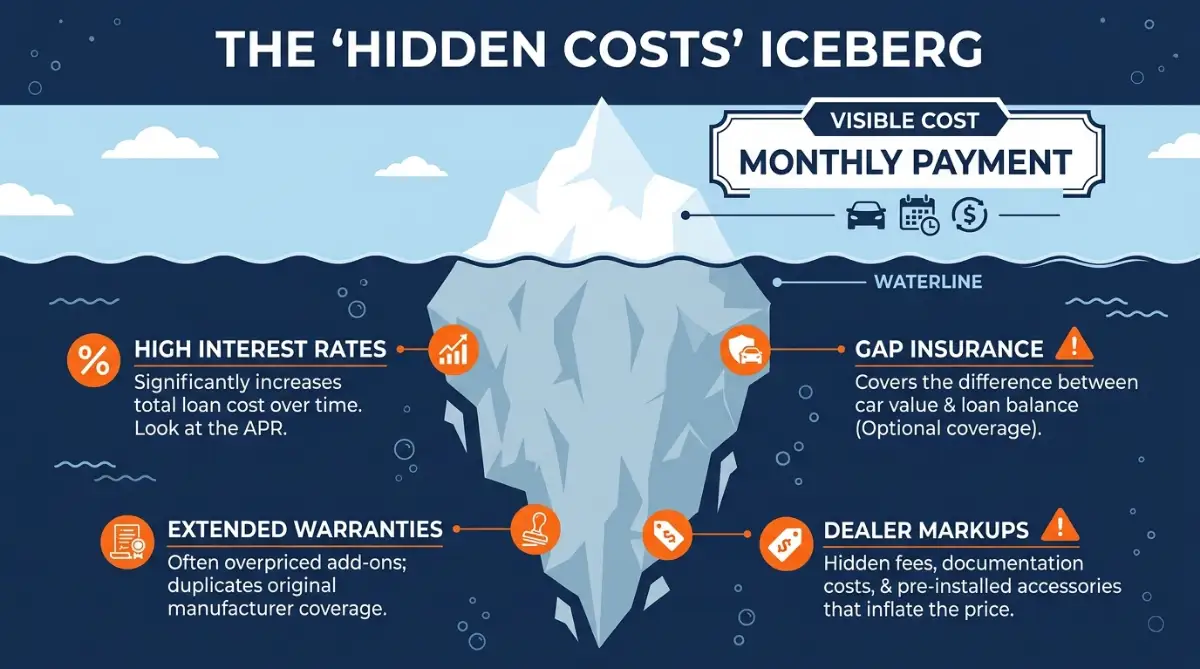
Once you agree on a great interest rate, the finance manager will try a different tactic to make a profit. They will pitch you extended warranties, tire protection plans, and GAP insurance.
They will say, "This only adds ten dollars to your monthly payment." While ten dollars sounds cheap, they are actually rolling thousands of dollars of overpriced products into your loan. You will be paying interest on those warranties for the next five years.
You do not have to buy these products at the dealership. You can usually buy GAP insurance directly from your normal auto insurance provider for a fraction of the cost. Always decline these finance room extras and shop for them independently later.
Trap 4: Obsessing Over the Monthly Payment
We touched on this earlier, but it is the single biggest trap in the auto industry. When a dealer asks what payment you want, they are setting a trap to extend your loan term.
If you say you only want to pay $400 a month, they might extend your loan out to 84 months at a terrible interest rate. Yes, your payment is $400, but you will pay thousands of extra dollars in interest over seven years.
Always negotiate based on the total out-the-door price of the vehicle and the exact APR (Annual Percentage Rate). If you focus only on the monthly bill, you are guaranteed to lose money in the long run.
Trap 5: Fearing Credit Inquiries Too Much
Many people are terrified of letting multiple banks check their credit. They wrongly assume that shopping around for the best rate will destroy their credit score.
Because of this fear, they just accept the very first rate the dealership offers them. This is a massive mistake that costs buyers dearly.
The credit bureaus understand that smart consumers compare rates. As long as you do all your auto loan shopping within a 14-day window, multiple inquiries will group together. Understanding the impact of credit inquiries on your score will give you the confidence to shop multiple lenders without fear.
Your Ultimate Action Plan for Dealership Success
You are now armed with the exact knowledge needed to beat the auto financing system. You understand the psychology, the math, and the hidden traps that catch ordinary buyers off guard.
Reading this guide is a fantastic first step, but knowledge is useless without execution. You must put these strategies into practice before you ever set foot on a dealership lot. Preparation is your absolute best defense against high-pressure sales tactics.
Do not let the excitement of a new vehicle cloud your financial judgment. A car is simply a tool to get you from point A to point B, but your financial peace of mind lasts a lifetime.
The 48-Hour Pre-Purchase Checklist
Before you head to the dealership, take exactly 48 hours to complete this simple checklist. First, check your credit report and correct any obvious errors.
Second, contact your local credit union and secure an independent pre-approval letter. This piece of paper is your ultimate shield against dealership markups. If you are struggling with other debts, remember that ignoring them is dangerous. Managing your budget properly is just as important as understanding the true cost of pausing your educational debt when trying to afford a new vehicle.
Finally, set a strict maximum budget for the total out-the-door price of the car. Write that number down on a piece of paper and promise yourself you will not go a single penny over it.
A Final Word of Encouragement
Taking control of your own financing isn't just about saving cash; it is about reclaiming your peace of mind so you can actually enjoy your new vehicle. You have the power to walk away and demand a fair deal, so start your preparation today and don't settle for anything less than what you deserve.
Negotiating does not have to be an aggressive or angry process. You are simply a smart consumer protecting your hard-earned money.
When you sit down with the finance manager, take a deep breath. Speak slowly, read every single line of the contract, and never be afraid to ask questions. If something feels wrong or the numbers do not add up, you have the absolute right to walk away.
You work incredibly hard for your income. Do not hand it away to a dealership just because they printed a confusing contract. Stand your ground, use your pre-approval leverage, and drive away knowing you secured the absolute best deal possible.
Disclaimer: The information provided in this article is for educational and informational purposes only. It does not constitute professional financial or legal advice. Interest rates, loan terms, and credit impacts vary based on individual circumstances and locations. Always consult with a certified financial advisor or legal professional before making any major financial decisions or signing legally binding loan agreements.