
The Heavy Weight of Waking Up Exhausted
Imagine your alarm goes off at 7:00 AM. You spent eight full hours in bed. You should feel fresh, right? But instead, your body feels like it is made of lead. Your eyes are heavy, and your brain feels trapped in a thick fog. This is a story many of us live every single day.
I know how it feels to stare at the ceiling, wondering why you are already defeated before the day begins. You drag yourself to the kitchen, hoping a dark cup of coffee will fix everything. But that energy boost is fake and short-lived. This constant struggle makes every task feel like a mountain you cannot climb.
Why Most Advice Fails You
When you tell someone you are tired, they usually say, "Just go to bed earlier." But you already tried that, and it did not work. People get stuck because they focus on the wrong things.
- Most people think sleep quantity is the only thing that matters.
- The internet is full of "quick fixes" like energy pills that actually ruin your heart health.
- You might be following "hacks" that work for others but ignore your body's unique needs.
- Many of us trust late-night snacks that steal our energy while we sleep.
- We often ignore the small habits that drain our batteries slowly over time.
How This Drains Your Spirit
This is not just about being sleepy; it is about your mental peace. When you are tired every morning, you start to lose faith in your own potential.
- You feel guilty because you think you are just being lazy or unmotivated.
- Your confidence drops when you cannot focus on your work or family.
- Constant fatigue makes you irritable, which can hurt your relationships with people you love.
- You stop chasing your dreams because you simply do not have the "gas" in the tank.
- The fear of never feeling "normal" again can lead to a very dark mental state.
The Real Reason Behind the Fog
Morning fatigue is often a loud scream from your body. It is telling you that something is out of balance. It is like a car that has a full tank of gas but a broken engine. You can put in all the gas (sleep) you want, but if the engine (metabolism/hormones) is not working, you won't move.
We live in a world where we are always "on." Our bodies are confused by artificial lights, strange eating times, and constant stress. This confusion leads to a state where your body survives but does not thrive. To fix this, we have to look past the bedroom door and see what else is going on.

Step 1: Quenching the Night-Time Desert
Did you know that you lose water just by breathing while you sleep? Think of your body like a plant. If you don't water it, it wilts. Most of us wake up in a state of mild dehydration. This makes your blood thicker and harder for your heart to pump.
When your blood is thick, it moves slowly. This means oxygen reaches your brain and muscles at a slower pace. That "heavy" feeling in your limbs is often just your cells begging for a drink. I always suggest having a glass of water right by your bed.
How to Hydrate Properly
Don't just chug water right before you sleep, or you will wake up for bathroom trips. Instead, try to drink small sips throughout the evening. When you wake up, make water your very first priority before touching any coffee.
Adding a tiny pinch of sea salt to your morning water can help too. It provides minerals that help the water actually enter your cells. You will notice that your brain "wakes up" much faster when it is properly hydrated. It is a simple change that costs nothing but gives back everything.
Step 2: Balancing the Sugar Rollercoaster
What you eat at night decides how you feel at sunrise. If you eat a big bowl of cereal or pasta late at night, your blood sugar spikes. Your body then pumps out insulin to bring it down. By the time morning comes, your sugar "crashes."
This crash makes you feel weak, shaky, and deeply tired. It is called the "Sugar Hangover." I have seen so many people fix their morning energy just by changing their last meal. You want your body to be a stable machine, not a wild ride.
Choosing the Right Fuel
Try to eat your last big meal at least three hours before you lie down. Focus on proteins and healthy fats rather than heavy carbs. A small piece of chicken or some nuts will keep your energy steady all night long.
When your blood sugar stays level, your body can focus on repairing your tissues. If it is busy fighting sugar spikes, it cannot fix your energy levels. Stable sugar means a stable mood and a fresh start the next day.
Step 3: Silencing the Digital Sun
Your body has a secret clock inside called the circadian rhythm. This clock looks for light to know when to be awake. The "blue light" from your phone or TV looks exactly like the sun to your brain.
When you scroll through social media at 11:00 PM, you are telling your brain it is mid-day. Your brain then stops making melatonin, which is the chemical that helps you sleep deeply. You might fall asleep, but your sleep will be "thin" and low quality.
Creating a Dark Sanctuary
Try to put your phone away at least one hour before bed. Use that time to read a real book or listen to soft music. If you must use a screen, use a "warm" filter to block the blue light.
Your bedroom should be as dark as a cave. Even small lights from a charger or a digital clock can disturb your deep sleep. When you give your brain total darkness, it rewards you with total energy in the morning. It is like giving your brain a chance to fully shut down and reboot.
Why Quality Beats Quantity Every Time
You might think ten hours of poor sleep is better than six hours of great sleep. But that is not true. Think of it like washing your clothes. If the machine just spins but has no soap or water, the clothes stay dirty.
Deep sleep is where the magic happens. This is when your body cleans out toxins from your brain. If you are constantly interrupted by light, noise, or bad digestion, you never reach that deep state. You wake up feeling "unwashed" and heavy.
I often tell my readers to focus on the environment of sleep. Is your room too hot? Is your pillow supporting your neck? Small physical discomforts keep your brain "awake" even if you are unconscious. Fix the small things, and the big energy will follow.
The Role of Morning Movement
Sometimes, you are tired because your blood is just "sitting still." You don't need a heavy gym session to wake up. Just five minutes of gentle stretching can signal to your heart that it is time to work.
Stretching pulls oxygen into your muscles and opens up your joints. It breaks that "stiff" feeling that makes you want to stay under the covers. Think of it as a gentle nudge to your nervous system. You are telling your body, "We are safe, and we are moving."
A Simple Morning Flow
Start by reaching for the sky while you are still in bed. Then, stand up and touch your toes. Take three deep breaths, filling your belly with air. This simple act changes your chemistry. It moves you from a "sleep state" to a "life state" almost instantly.
Listening to Your Body’s Natural Language
We often ignore the subtle signs our body gives us. If you feel tired after every meal, that is a sign. If your eyes hurt after an hour of work, that is a sign. Learning to listen to these whispers helps you prevent the loud "scream" of chronic fatigue.
Every person is different. What works for me might need a small tweak for you. But the basics of water, light, and food are the same for everyone. You are a biological being, and you need to follow biological rules.
Don't be hard on yourself if you don't feel perfect on day one. It takes time for your "engine" to find its rhythm again. Keep showing up for yourself. The rewards of a bright, energetic morning are worth every single effort. You deserve to wake up and feel excited for the day ahead.
Mastering Your Internal Climate for Deep Recovery
We often think about our blankets and pillows when we talk about sleep. But there is a hidden factor that decides how you feel at 8:00 AM: Core Body Temperature. Your body needs to cool down to enter the deep stages of sleep where actual healing happens.
If your bedroom is too warm, your heart has to work harder to pump blood to your skin to cool you off. This keeps your system in a state of low-level stress all night long. You wake up feeling like you ran a marathon because your body never truly rested.
The Thermal Comfort Zone
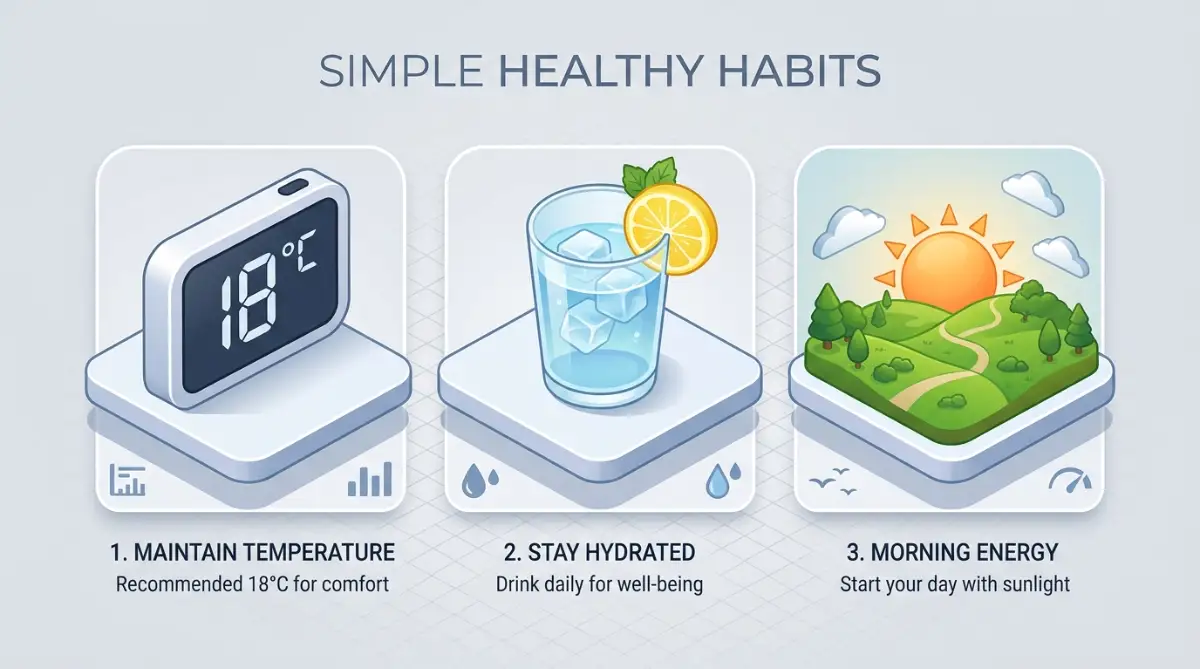
Try to keep your room temperature around 18 degrees Celsius. This might sound cold, but it is the sweet spot for human recovery. When your environment is cool, your brain triggers the release of melatonin more effectively.
If you cannot control the room temperature, try a warm bath ninety minutes before bed. When you step out of the warm water, your body temperature drops rapidly. This natural drop signals to your brain that it is time for a deep, restorative shutdown.
The Golden Hour of Natural Sunlight
There is a tiny part of your brain that acts like a master clock. It looks for one specific thing every morning to set your energy levels: Natural Sunlight. When bright light hits your eyes early in the day, it tells your brain to stop making sleep hormones.
This light also triggers the release of cortisol, which is your body's natural "wake-up" chemical. If you spend your whole morning in a dark room or under dim office lights, your brain stays confused. You end up feeling sleepy until lunch because your internal clock hasn't been "reset."
Try this expert routine for better energy:
- Step outside within thirty minutes of waking up.
- Spend at least ten minutes in the sun without wearing sunglasses.
- If it is a cloudy day, spend twenty minutes outside to get enough light.
- Keep your workspace near a window to maintain alertness throughout the day.
The Magnesium Connection
Many people struggle with morning stiffness and fatigue because of a simple mineral imbalance. Magnesium is responsible for over three hundred reactions in your body, including how your muscles relax. If you are low on magnesium, your muscles stay tense even while you sleep.
This tension prevents you from reaching the deepest levels of physical repair. You wake up feeling tight, sore, and mentally drained. Adding magnesium-rich foods like spinach, almonds, or pumpkin seeds to your dinner can make a huge difference. It acts like a natural relaxant for your nervous system, allowing for a "quiet" night.
Guidelines for Long-Term Energy Stability
Staying energetic is not a one-time event; it is a lifestyle of Consistency. Your body loves a predictable rhythm. If you wake up at different times every day, you are giving your brain "social jetlag."
Try to wake up and go to bed at the same time, even on weekends. This trains your hormones to peak and drop at the right moments. After a few weeks, you will notice that you start waking up naturally just before your alarm goes off. That is a sign that your body is finally in sync with its natural environment.
How to maintain this progress:
- Audit your evening routine every month to see what is stealing your energy.
- Listen to your hunger cues and notice if late-night eating makes you groggy.
- Track your morning mood in a small journal to find your own energy patterns.
- Stay patient because it takes time for your hormones to find their new balance.
Five Traps That Are Secretly Stealing Your Morning Power
Sometimes, it is not about what you aren't doing, but what you are doing wrong. I have seen many people work hard on their health only to be held back by small, daily mistakes. Let's look at the most common pitfalls that keep you trapped in a cycle of exhaustion.
1. The Dangerous Snooze Button Cycle
We all love those extra nine minutes of sleep, but they are a lie. When you hit snooze, you tell your brain to start a brand new sleep cycle. But since you only have a few minutes, you wake up in the middle of that cycle.
This causes something called sleep inertia, which is that heavy, "hungover" feeling. It can take up to four hours for your brain to fully recover from a snooze-button wake-up. It is much better to set your alarm for the actual time you need to get up and stand up immediately.
2. Drinking Coffee the Moment You Wake Up
This is the most common mistake in the world. When you wake up, your cortisol levels are naturally high to help you start the day. If you drink caffeine at 7:00 AM, you interfere with this natural process.
Your body starts to rely on the coffee instead of its own natural hormones. This leads to a massive energy crash around 2:00 PM. Wait ninety minutes after waking up before having your first cup of coffee to let your body do its own work first.
3. Starting the Day with a Sugar Spike
Cereal, white bread, and sugary fruit juices are common breakfast choices. But these foods cause your blood sugar to go through the roof. Your body responds with a flood of insulin, which leads to a sugar crash shortly after.
This crash makes you feel sleepy and hungry again within two hours. Switch to a breakfast high in protein and healthy fats, like eggs or avocado. This provides a slow, steady burn of energy that lasts until your next meal.
4. Ignoring the Evening Blue Light Filter
We talked about light in the morning, but light at night is just as powerful. Using your phone or tablet in bed tells your brain that it is still daytime. This blocks the production of sleep hormones for hours.
If you must use your devices, turn on the "night mode" or use orange-tinted glasses. Better yet, leave the phone in another room. This simple boundary tells your brain that the day is officially over.
5. The "Catch-Up" Sleep Fallacy
Many people sleep five hours during the week and twelve hours on Saturday. This does not help you "catch up" on lost energy. Instead, it confuses your internal clock even more.
It makes it much harder to fall asleep on Sunday night, leading to a miserable Monday morning. Try to keep your weekend sleep within one hour of your weekday routine. This keeps your energy levels stable throughout the entire week.
Taking the First Step Toward a Brighter Life
Waking up with energy is a gift you can give to yourself every single day. It changes how you see your work, your family, and your future. You no longer have to live as a person who is "always tired."
You now have the tools to regulate your temperature, master natural light, and avoid the common traps. These changes might seem small, but their impact is Life-Changing. You deserve to feel the sun on your face and feel ready to take on the world.
Start tonight by cooling down your room. Tomorrow morning, step outside and breathe in the fresh air. You will be surprised at how quickly your body remembers how to be alive. Let today be the last day you let fatigue hold you back from your true potential.
Final Actionable Steps for You:
- Optimize your bedroom for coolness and total darkness tonight.
- Delay your caffeine tomorrow morning until you have been awake for over an hour.
- Eat a protein-rich breakfast to keep your energy steady all day long.
- Share this knowledge with a friend who is also struggling with low energy.
You are capable of so much more when you aren't fighting your own body. Take these steps, stay consistent, and enjoy the incredible energy that is waiting for you. Your journey to a better morning starts the moment you decide to take control. Prioritizing consistent self-care is the most powerful investment you can make for your future self."