
Finance Loan Guide: What Really Influences Your Mortgage Interest Rate?
I remember sitting at my kitchen table with a stack of bank statements, convinced that my high credit score would make getting a mortgage a total breeze. I was shocked when the first few quotes I received were nothing like what I saw online. It turns out, I was looking at my finances through a tiny straw while the lenders were looking at the whole picture, and that realization changed everything for my home-buying journey.
Buying a home can feel like a numbers game. You check your credit score, estimate your down payment, compare lenders, and expect the mortgage rate to follow.
But your credit score is only one piece of the puzzle.
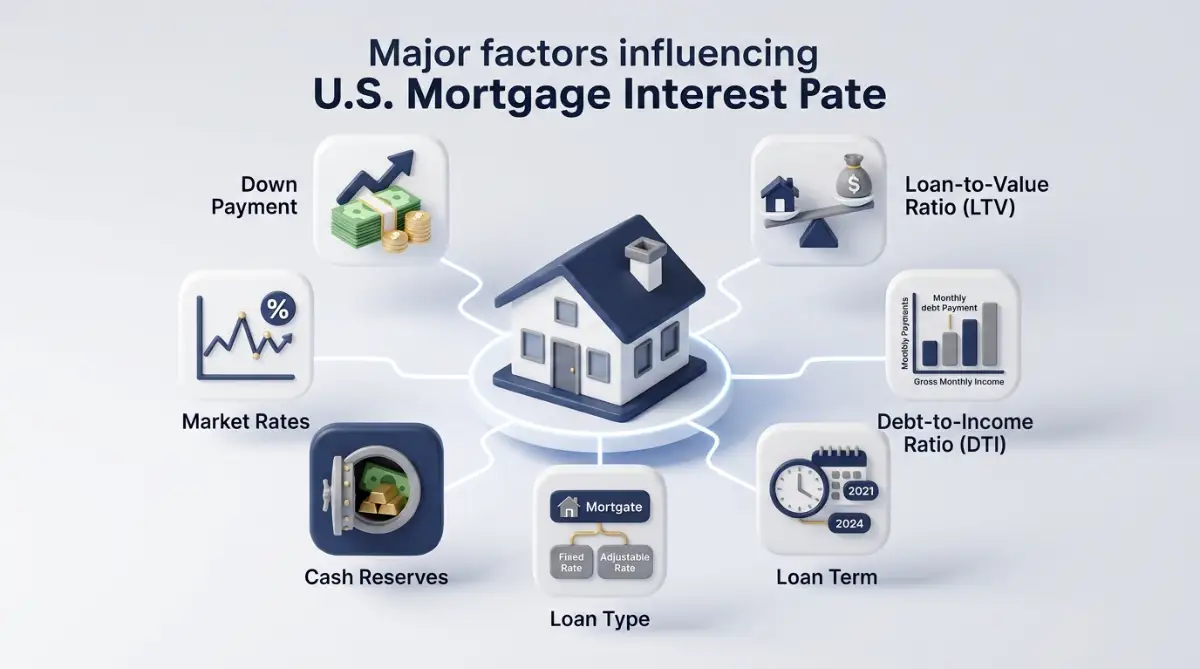
This Finance Loan Guide explains the other factors that can influence the mortgage interest rate you receive. Your debt-to-income ratio, loan-to-value ratio, loan type, property type, loan term, down payment, cash reserves, and even broader financial market conditions can all matter.
That means two borrowers with similar credit scores may receive different mortgage offers. For example, imagine two buyers who both have a 740 credit score. One has a 25% down payment, low monthly debt, strong cash reserves, and a conventional 30-year mortgage. The other has a 5% down payment, several monthly debts, and a different loan structure.
Their credit scores look similar, but their overall risk profiles are not. That is why understanding the full picture can help you prepare before applying. This Finance Loan Guide will walk you through the major factors lenders consider, how they can affect your rate, and practical steps you can take before requesting mortgage quotes.
You will also learn why a Student Loan can matter even when you have never missed a payment, why the property itself can influence pricing, and why a rate you see online may not be the rate you personally receive. The goal is simple: give you a clearer way to compare mortgage offers and make smarter decisions.
Finance Loan Guide: Why Your Credit Score Is Not the Whole Story
Your credit score matters. A strong score can help you qualify for better mortgage pricing, but lenders generally look at more than one number. The CFPB notes that lenders may also consider your credit report, debt, savings, assets, income, and other information when evaluating a mortgage application.
Think of your application as a complete financial picture.
The key lesson from this Finance Loan Guide is that improving one area may not automatically produce the lowest possible mortgage rate.
Instead, you want your overall application to look as strong and stable as possible.

1. Your Down Payment Can Change Your Mortgage Rate
Your down payment is one of the most visible factors affecting your mortgage application.
A larger down payment usually means you borrow less compared with the property's value. That lowers your loan-to-value ratio, commonly called LTV.
For example:
A lower LTV generally represents less lender risk.
The CFPB explains that lenders can use LTV when determining how much someone can borrow, whether mortgage insurance may be required, and what interest rate may be offered. Higher LTV can mean higher pricing.
Finance Loan Guide Tip: Don't Empty Your Savings
A larger down payment can help, but that does not mean you should put every dollar into the house. You may still need money for closing costs, moving expenses, repairs, emergencies, and future homeownership costs.
A good Finance Loan Guide strategy is to compare the savings from a larger down payment against the value of keeping cash available.Looking back, my biggest mistake was thinking that dumping every extra dollar into my down payment was the smartest move. I learned the hard way that having a healthy cash reserve is just as important as a low interest rate, especially when unexpected home repairs pop up in the first few months. Don't be afraid to keep some "breathing room" in your savings account—it buys you peace of mind that no mortgage rate can match.
2. Your Debt-to-Income Ratio Matters
Your debt-to-income ratio, or DTI, measures your monthly debt payments against your gross monthly income.
Suppose you earn $8,000 per month before taxes and have $2,800 in qualifying monthly debt payments.
Your DTI would be:
$2,800 ÷ $8,000 = 35%
A lower DTI can make your application look stronger because it suggests more of your income remains available after debt payments.
Fannie Mae defines DTI using monthly obligations and qualifying income, and its underwriting guidance places limits on DTI depending on the loan and underwriting method.
This is where existing debt becomes important.
Student Loan Debt Can Affect Your Mortgage Application
A Student Loan does not automatically prevent you from getting a mortgage.
However, the required monthly payment may be included when your lender evaluates your debt obligations.
Other debts can count too:
- Auto loans
- Credit card minimum payments
- Personal loans
- Alimony or child support where applicable
- Other qualifying installment debt
- Student Loan payments
If your DTI is high, paying down certain debts before applying may improve your overall application.
The best move depends on your situation, so compare the benefit of reducing debt with the need to maintain enough cash for the home purchase.
3. Your Loan-to-Value Ratio Is More Important Than Many Buyers Realize
LTV is closely connected to your down payment, but it deserves separate attention.
The basic calculation is:
Loan Amount ÷ Property Value × 100 = LTV
If you borrow $360,000 on a $400,000 home:
$360,000 ÷ $400,000 × 100 = 90% LTV
A 90% LTV is different from an 80% LTV.
Fannie Mae's guidance also shows that LTV requirements can depend on factors such as credit score, mortgage product, occupancy, and property characteristics.
So when comparing offers, don't look only at the interest rate.
Check whether changing your down payment changes:
- Your interest rate
- Mortgage insurance
- Monthly payment
- Cash required at closing
- Total borrowing cost
This Finance Loan Guide approach can reveal that the cheapest-looking rate is not always the cheapest overall loan.
4. Your Mortgage Loan Type Can Change the Rate
Not every mortgage is priced the same.
You might compare:
- Conventional loans
- FHA loans
- VA loans
- USDA loans
- Fixed-rate mortgages
- Adjustable-rate mortgages
Each product has different eligibility rules, costs, and risk characteristics.
A borrower may see a lower advertised rate for one mortgage type but face different mortgage insurance, fees, or future payment risks.
An adjustable-rate mortgage, for example, can change after its initial fixed period. ARMs generally include caps that limit how much the rate can increase or decrease during adjustments.
That means you should compare the complete loan structure rather than choosing based on the headline rate alone.
5. The Length of Your Mortgage Changes Pricing
The loan term also matters.
The most common comparison is between a 30-year and 15-year mortgage.
A 15-year loan typically requires larger monthly payments because you repay the balance faster. But you may pay substantially less interest over the full life of the loan.
A 30-year loan spreads repayment over a longer period, which can make monthly payments more manageable.
Your Finance Loan Guide comparison should include:
Do not assume one term is automatically better.
The right choice depends on your income, savings, future plans, and comfort with the monthly payment.
6. The Type and Location of the Property Can Matter
Still confused about how different loan terms impact your monthly budget? Watch this quick breakdown to see how a few small changes can save you thousands over the life of your loan.
The property itself can affect mortgage pricing.
A primary residence may be treated differently from an investment property or second home.
Why?
Because lenders evaluate risk differently depending on how the property will be used.
Property characteristics can also matter. A single-family home, condominium, manufactured home, or multi-unit property may have different underwriting considerations.
The appraisal is another important part of the process.
If the property appraises for less than expected, your loan-to-value calculation may change. That can affect the terms or require you to bring more money to closing.
The CFPB notes that changes involving the appraisal, loan amount, down payment, or other application information can lead to a revised Loan Estimate.
7. Your Cash Reserves Can Strengthen Your Application
Imagine two buyers have identical credit scores and similar incomes.
Buyer A has $4,000 left after closing.
Buyer B has $35,000 in savings after closing.
The second borrower may appear financially better prepared to handle unexpected expenses.
Cash reserves do not guarantee a lower rate, but lenders may consider assets and savings when evaluating borrowers. The CFPB specifically lists savings and total assets among factors lenders may consider.
This is especially useful to remember if you are tempted to spend every available dollar on your down payment.
Sometimes keeping a healthy financial cushion is more useful than putting the final dollars toward the house.
8. Mortgage Rates Also Follow the Broader Financial Market
This is the factor you have the least control over.
Mortgage rates do not simply move according to your personal credit score.
Broader financial conditions influence the rates lenders offer.
Fannie Mae explains that 30-year mortgage rates are linked to the bond market and influenced by factors including the 10-year Treasury yield, inflation expectations, economic growth, and other market conditions.
Freddie Mac also explains that mortgage rates are affected by both market conditions and borrower-specific factors.
So you could have excellent credit and still receive a higher mortgage rate during a period of elevated market rates.
You cannot control the market.
But you can control how carefully you shop.
9. Your Rate Lock Can Protect Your Mortgage Rate
A mortgage rate can change between the time you apply and the time you close.
That is where a rate lock comes in.
A rate lock generally means the lender agrees to keep the interest rate unchanged for a specified period, assuming the transaction closes within that period and the application does not materially change.
Common questions to ask include:
- How long is the rate locked?
- Is there a rate-lock fee?
- What happens if closing is delayed?
- Can I get a longer lock?
- What happens if rates fall after I lock?
- Can my rate change because of an application change?
The CFPB recommends checking the Loan Estimate to see whether the rate is locked and until when.
Finance Loan Guide Rate-Lock Checklist
Before signing, confirm:
1. Lock period — Know the exact expiration date.
2. Extension cost — Ask what happens if closing is delayed.
3. Float-down policy — Ask whether you can benefit if rates fall.
4. Application changes — Understand what could invalidate the lock.
This small conversation can prevent a major surprise later.
10. Discount Points Can Change the Rate You Receive
You may have the option to pay discount points to reduce your mortgage interest rate.
In simple terms, you pay more upfront in exchange for a lower rate.
But the important question is not simply:
"Can I get a lower rate?"
Ask:
"How long will it take for my monthly savings to recover the upfront cost?"
For example, suppose paying points costs $4,000 and saves you $100 per month.
Your approximate break-even period would be:
$4,000 ÷ $100 = 40 months
If you expect to keep the mortgage well beyond that point, the lower rate may make sense.
If you plan to sell or refinance sooner, paying the points may not provide enough time to recover the cost.
Finance Loan Guide: How to Compare Mortgage Offers
Once you have several quotes, avoid comparing only the interest rates.
Ask each lender for the same loan structure.
For example:
$400,000 home, 20% down, conventional, 30-year fixed
Then compare:
- Interest rate
- APR
- Monthly principal and interest
- Mortgage insurance
- Origination charges
- Discount points
- Lender credits
- Closing costs
- Cash required to close
- Rate-lock period
The CFPB recommends requesting the same type of loan from multiple lenders when comparing Loan Estimates.
This makes the comparison much cleaner.
A Simple Real-World Example
Let's say Alex and Jordan both have a 740 credit score.
Alex has:
- 20% down
- 30% DTI
- Strong cash reserves
- Primary residence
- Conventional 30-year fixed loan
Jordan has:
- 5% down
- 45% DTI
- Limited reserves
- Different property type
- Different loan structure
Their credit scores are identical.
Yet their mortgage offers may still differ because the rest of their financial profiles are different.
That is the main lesson of this Finance Loan Guide: your credit score is important, but it is not the entire pricing equation.
Finance Loan Guide: 7 Steps to Improve Your Position Before Applying
You don't need to change everything at once.
Use this simple process.
Step 1: Check Your Credit Reports
Look for errors, outdated information, or accounts you do not recognize.
Correcting mistakes early gives you more time before mortgage underwriting.
Step 2: Calculate Your DTI
Add your qualifying monthly debt payments and divide them by your gross monthly income.
Include your Student Loan, auto loan, credit card minimums, and other applicable debts.
Step 3: Test Different Down Payments
Compare 5%, 10%, 15%, and 20% scenarios if they fit your finances.
Do not sacrifice your emergency fund just to reach a specific percentage.
Step 4: Avoid New Debt
Large purchases before closing can change your debt profile.
A new auto loan or credit account could affect your application.
Step 5: Gather Income Documents
Prepare pay stubs, tax documents, bank statements, and other requested records.
Step 6: Compare Multiple Lenders
Don't assume your current bank has the best offer.
Request comparable Loan Estimates.
Step 7: Review the Rate Lock
Before accepting the offer, understand exactly when the rate becomes fixed and what could cause it to change.
This Finance Loan Guide process gives you a practical checklist rather than relying on a single credit-score number.
Finance Loan Guide FAQ
Does my credit score determine my entire mortgage interest rate?
No. Your credit score is important, but lenders can also consider your debt, income, assets, down payment, LTV, loan type, property, and broader market conditions. Two borrowers with similar scores can receive different mortgage pricing because their overall risk profiles differ.
Can a Student Loan affect my mortgage interest rate?
Yes, indirectly. A Student Loan payment may be included in your debt-to-income calculation. A higher DTI can affect how much you qualify for and may influence the overall strength of your mortgage application. The exact treatment depends on the loan program and lender.
Does a larger down payment always mean a lower mortgage rate?
Not necessarily, but a larger down payment generally lowers your loan-to-value ratio and can reduce lender risk. It may also affect mortgage insurance costs. Compare the rate, monthly payment, insurance, closing costs, and remaining cash before deciding how much to put down.
Can mortgage rates change after I apply?
Yes. Unless your rate is locked under the lender's terms, mortgage rates can change. Even a locked rate can sometimes change if important application details change or the lock expires. Always ask your lender about the lock period and extension rules.
Should I compare APR or interest rate?
Compare both. The interest rate determines the borrowing rate, while APR incorporates the interest rate plus certain loan costs and can make it easier to compare the overall cost of different offers. Still, review the complete Loan Estimate rather than relying on APR alone.
Final Takeaway: Build a Stronger Mortgage Application
I know that staring at debt ratios and loan terms feels overwhelming, but you honestly have more control over this process than you think. You have the power to shape your financial story right now, and every small step you take today makes your future home that much more secure. Take a deep breath, trust the process, and start building your path to ownership—you have definitely got this.
Your credit score deserves attention, but it should not be the only number you watch. Your down payment, LTV, DTI, income, savings, mortgage type, property, loan term, discount points, and market conditions can all shape the mortgage offer you receive.
Your existing Student Loan may also matter because its payment can affect your debt-to-income ratio. The good news is that several of these factors are within your control. You can reduce unnecessary debt. You can build savings. You can compare lenders. You can choose a loan structure that fits your budget. And you can ask detailed questions before locking your rate.
Don't focus only on finding the lowest advertised rate. Focus on finding a mortgage that works for your entire financial situation. Before you apply, calculate your DTI, review your credit reports, estimate your LTV, organize your financial documents, and request comparable Loan Estimates from multiple lenders.
Then compare the complete cost—not just the headline number. Use this Finance Loan Guide as your starting checklist, and take your time before committing to a mortgage offer. A few careful decisions before closing can make a meaningful difference over years of homeownership.
CTA: Ready to shop for a mortgage? Compare multiple lenders, ask for detailed Loan Estimates, and review every cost before choosing your loan.