
The Hidden Financial Barrier Standing Between You and Your Dream Home
Have you ever sat in a bank manager's office, sweating a little, hoping they say "yes" to your mortgage application? I’ve seen so many people get their hearts broken right at that desk, not because they don't make enough money, but because of one simple math problem they didn't know about. Let me show you exactly how bankers look at your money, so you can walk in there knowing you're already approved.
This is a heartbreaking reality for thousands of hopeful buyers every single day. The rejection often comes down to one hidden mathematical formula that lenders use to judge your financial health.
When you do not understand how banks view your money, the entire home-buying process feels like an impossible puzzle. You end up wasting time looking at properties you can never get approved for. Let us look at why so many people fail to fix this problem before it is too late:
- Trusting outdated online advice: Many buyers read random forums and assume their credit score is the only thing that matters. They completely ignore how their monthly spending affects their borrowing power.
- Listening to well-meaning family members: Relatives often share stories from decades ago when borrowing rules were completely different. This creates a false sense of security.
- Guessing their exact income: People often confuse the money they take home with the money they actually earn on paper. This simple mistake ruins the entire calculation.
- Hiding small debts: Buyers sometimes think a small personal loan or a store credit card will not show up on a bank review. Lenders see absolutely everything.
- Fear of rejection: Every time the phone rings, you panic thinking the bank is calling to deny your application.
- Sleepless nights: You lie awake trying to do complex math in your head, wondering if you make enough money to afford the monthly payment.
- Relationship tension: Couples often argue about money simply because neither partner understands exactly how much home they can safely afford.
- Missed opportunities: While you wait and worry, other prepared buyers swoop in and purchase the homes you really loved.
You do not have to live with this anxiety. When you finally learn the exact math the banks use, you take back all of your power. You can walk into any lender's office with absolute confidence. Let me show you exactly how to break down the numbers so you can protect your dream.

How to Discover Your Real Purchasing Power
Your Quick Action Plan (TL;DR)
-
Your Debt-to-Income (DTI) ratio is the secret math banks use to approve or deny your home loan.
-
Always use your gross income (before taxes) and only count fixed monthly debts (like car payments and credit cards).
-
Keep your total ratio below 36% to get the best interest rates and avoid rejection.
-
Never buy new furniture on credit or open new accounts before you actually have the house keys in your hand!
Lenders use a very specific formula to decide if you are a safe bet. They want to know if you can comfortably pay your mortgage without starving or missing other bills. This magical number is known as your DTI.
I am going to walk you through exactly how to calculate your debt-to-income ratio for a house loan. We will use simple math and real-life examples. You do not need an accounting degree to master this. Let us break it down into simple, actionable steps you can start right now.
Step 1: Pinpointing Your True Monthly Gross Income
The very first thing you must do is figure out exactly how much money you make. However, banks do not care about the money deposited into your checking account after taxes. They look at your gross monthly income.
Gross income is the total amount of money you earn before the government takes out taxes, insurance, or retirement contributions. Think of your income like a whole pie. The gross income is the entire pie before anyone cuts a slice.
If you are a standard salaried employee, finding this number is very easy. You simply take your total annual salary and divide it by twelve. For example, if your company pays you $60,000 a year, your gross monthly income is exactly $5,000.
But what if you get paid by the hour? Let us imagine you earn $20 an hour and work 40 hours a week. First, multiply $20 by 40 to get your weekly pay, which is $800. Then, multiply $800 by 52 weeks to find your yearly total of $41,600. Finally, divide that by 12. Your gross monthly income is $3,466.
Things get a little trickier if you are a freelancer or a small business owner. Lenders view self-employment income as a higher risk. They usually want to see your tax returns from the last two years.
Myth vs. Fact: Self-Employed Income
Myth: "I can just show the bank my big bank deposits from client payments!"
Fact: The bank only cares about your "net profit" on your tax returns. If you wrote off a bunch of business expenses to save on taxes, you also lowered the income the bank uses to qualify you for a loan. Keep this in mind before filing your taxes if you plan to buy a house soon!
If you are self-employed, you need to add your net profit from the last 24 months and divide it by 24 to find your monthly average. For instance, if you made $40,000 your first year and $60,000 your second year, your total is $100,000. Divide that by 24, and your monthly average is $4,166.
Do not forget extra income sources. You can also include child support, alimony, or disability payments if they are steady and documented. Just make sure you have the official paperwork to prove this money will continue coming in for at least the next three years.
Step 2: Adding Up Your Hard Monthly Debts
Now that we have your income sorted, we need to look at your outgoing money. This step is where most people make huge mistakes. You do not need to count every single dollar you spend.
Banks only care about recurring, fixed debt obligations. They want to know about the bills that report to credit bureaus. They do not care about your Netflix subscription, your monthly grocery bill, or how much you spend on gas.
So, what exactly should you include in this list? You must count the minimum monthly payment on all your credit cards. You must also include your car loan payments, student loan payments, and any personal installment loans.
Let us look at a real-life scenario to make this crystal clear. Meet Sarah. Sarah wants to buy a house, so she sits down to calculate her debts. She looks at her credit card statement. Her total balance is $2,000, but her minimum monthly payment is only $50.
For the bank's calculation, Sarah will only write down $50. Next, she adds her car payment, which is $300 a month. Finally, she includes her student loan, which is $150 a month.
When Sarah adds these numbers together ($50 + $300 + $150), she finds her total monthly debt is exactly $500. It really is that simple. You just need to be completely honest with yourself when making this list.
What counts as "Debt"?
✅ Include These: Credit card minimum payments, Car loans, Student loans, Child support you pay out, Personal loans.
❌ Ignore These: Groceries, Cell phone bills, Netflix/Spotify, Car insurance, Utility bills, Gym memberships.
What if you co-signed a loan for your brother's car? Unfortunately, you must include that payment in your total debt. Even if your brother pays it every month, the bank considers you legally responsible. If he stops paying, the bank expects you to cover the bill.
Take a piece of paper right now and write down your official debts. Ignore your phone bill, your electric bill, and your health insurance premiums. Focus strictly on loans, credit cards, and legal obligations like child support payments you must make to an ex-spouse.
Step 3: Doing the Simple Division Math
You now have the two most important numbers of your financial life. You know your gross monthly income, and you know your total monthly debt. The final step is incredibly simple division.

To calculate your exact percentage, you take your total monthly debt and divide it by your gross monthly income. Once you get that decimal number, you simply multiply it by 100 to turn it into a percentage.
Let us practice with an easy example. Imagine a man named David. David has a gross monthly income of $6,000. He also has a total monthly debt of $1,200 from his car, student loans, and credit cards.
David grabs his calculator. He types in 1,200 and divides it by 6,000. The calculator shows the number 0.20. David then multiplies 0.20 by 100. His final number is 20%.
This means David spends exactly 20% of his pre-tax income on his current debts. This is a remarkably strong and healthy number. Lenders would look at David's profile and immediately see a low-risk borrower who manages money well.
Let us try another scenario with a couple, Mark and Lisa. Together, their combined gross monthly income is $8,000. However, they have heavy student loans, two expensive car payments, and large credit card bills. Their total monthly debt is $3,600.
They do the exact same math. They divide 3,600 by 8,000, which gives them 0.45. They multiply by 100 and get 45%.
This number is quite high. A 45% ratio means nearly half of their income is already promised to other banks before they even pay for groceries or their future mortgage. Many lenders will view Mark and Lisa as high-risk borrowers.
Why is this exact percentage so incredibly important to the bank? Statistical data proves that people with high debt burdens are much more likely to miss their mortgage payments. The bank wants to protect its investment.
When a financial emergency happens, like a sudden medical bill or a job loss, people with heavy debt instantly sink. Lenders use this simple math formula as a protective shield. It protects the bank from losing money, and honestly, it protects you from losing your home to foreclosure.
By doing this math at home today, you are taking control of your future. You do not have to sit nervously in a bank office waiting for a stranger to judge your life. You can look at your percentage right now and know exactly where you stand.
If your number is too high, you have time to fix it before you ever fill out an application. You can pause your house hunting, pay down some small credit cards, and instantly improve your score. Knowledge truly is power when it comes to buying real estate.
Smart Strategies to Lower Your Numbers Fast
Now that you know your exact percentage, you might feel a little worried if the number is too high. Do not panic at all. Financial experts agree that you can actively change your ratio before the bank ever sees your application.
By understanding the standard debt-to-income guidelines, you can strategically restructure your finances right now. Lenders simply want to see that you manage your money responsibly. You have full control over how your financial profile looks on paper.
The main goal is to get your total percentage well below 36% for the best possible loan terms. This target perfectly aligns with official government recommendations for safe and sustainable home buying.
When your ratio is nice and low, banks will actually fight for your business. This is the absolute best way of securing the lowest interest rates available on the market today. Lower interest rates mean you will save tens of thousands of dollars over the life of your mortgage.
I want to share a few insider secrets that smart buyers use to quickly drop their monthly obligations. These are proven, simple methods that can completely save a failing application. Let us look at a few highly practical ways to clean up your financial profile today.
Eliminate Small Balances for Immediate Relief
One of the fastest ways to improve your math is to completely pay off small credit card balances. Remember, the bank cares about your minimum monthly payment, not necessarily the total amount you owe.
Imagine you have a department store credit card with a balance of just $500. The minimum monthly payment on that card is $50. If you take $500 from your savings and pay that card off completely, that $50 payment vanishes from your monthly debt list.
By removing just three small store cards, you could easily wipe out $150 in monthly debt. This small change instantly lowers your ratio and increases your buying power. It is a very cheap way to make your bank application look incredibly strong.
Restructure Your Existing Heavy Liabilities
Sometimes, you cannot simply pay off a massive balance from your savings account. If you have large credit card bills with very high minimum payments, you might need a different strategy. You can look into consolidating your high-interest bills into one single, manageable payment.
For example, taking out a personal loan with a longer repayment term can drastically lower your required monthly payout. If you are curious about how this works, you should look into safely managing unsecured personal financing options to see if it fits your situation.
Let us say your current credit card minimums total $600 a month. By consolidating them into a fixed personal loan, your new monthly payment might drop to $300. You just freed up $300 a month, making you look much more attractive to a mortgage lender.
Safely Boosting Your Verifiable Income
If you cannot lower your debts any further, the only other option is to increase your gross income. However, you must do this in a way that the bank can actually verify and trust. Under-the-table cash jobs will not help you buy a house.
If you are due for a raise at your current job, now is the perfect time to ask your boss for it. Even a small hourly increase makes a big difference when multiplied over an entire year. You can also pick up verifiable overtime hours if your company allows it.
If you decide to start a side hustle, make sure every single dollar is deposited into a bank account and reported on your taxes. Lenders love to see increasing income, but they demand a clear paper trail. Keep your pay stubs and tax documents highly organized in a dedicated folder.
How to Maintain This Financial Health Long-Term
Getting your numbers looking good is only half the battle. Keeping them healthy while you shop for a home is entirely different. You need a simple, reliable system to manage your cash flow every single week.
Start by creating a rigid household budget that tracks every single outgoing dollar. When you see exactly where your money goes, you naturally stop overspending. This helps you avoid putting new charges on your credit cards.
Always pay your bills on time, every single month, without fail. Set up automatic payments so you never accidentally miss a due date. A single late payment can wreck your credit score and completely ruin your chances of getting approved for a mortgage.

Five Dangerous Traps That Will Ruin Your Application
Even with perfect math, many hopeful buyers accidentally destroy their own applications right before closing day. The mortgage process is highly sensitive. One wrong move can cause the underwriter to deny your loan at the very last minute.
You must protect your financial profile like a guard dog while you are shopping for a home. Any sudden changes will trigger massive red flags for the bank. Here are the most common traps you must completely avoid during this delicate time.
1. Opening New Credit Lines Too Close to Closing
This is the number one reason people lose their dream homes. A buyer gets excited about their new house and decides to buy new furniture on credit. They walk into a store, open a new line of credit, and finance a $5,000 living room set.
The moment that new loan hits your credit report, your debt ratio skyrockets. The bank will pull your credit one final time just days before you sign the house papers. If they see this new furniture payment, they will likely cancel your entire mortgage.
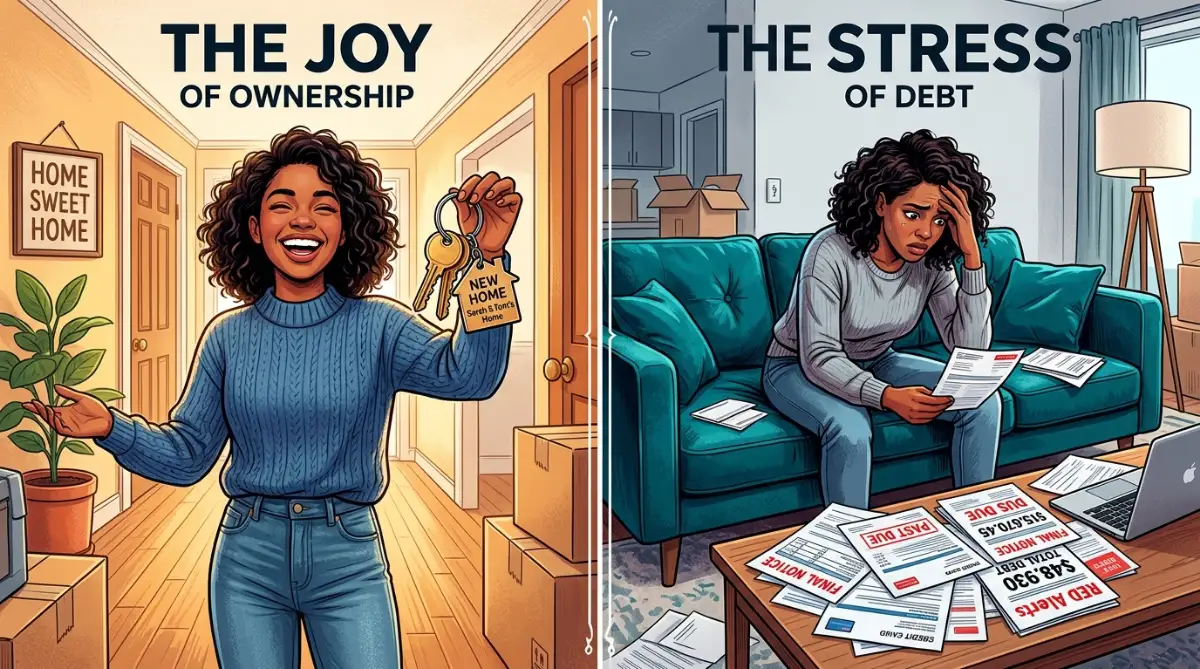 Never open any new credit accounts until the keys to the house are physically in your hands. Sleep on an air mattress in your new home if you have to. Do not risk your mortgage for a new sofa.
2. Ignoring Errors on Your Background Check
Lenders rely entirely on the data provided by the major credit bureaus. Unfortunately, these bureaus make mistakes all the time. Sometimes, they mix up your files with someone who has a similar name.
You might have a collection account showing on your file that actually belongs to a stranger. This fake debt will unfairly inflate your ratio. You need to know how one wrong digit on your credit report can drop your score and ruin your buying chances.
Pull your official credit report at least six months before you apply for a home loan. Read through every single line carefully. Dispute any errors immediately, because the investigation process can take several months to resolve.
3. Forgetting About Unseen Borrowing Costs
When people calculate their housing budget, they often only think about the principal and the interest. They completely forget about the silent costs of owning a home. These hidden numbers will significantly change what you can actually afford.
Your lender will include property taxes, home insurance, and potential neighborhood association fees in your total monthly obligation. If you ignore these, your math will be completely wrong. You also need to be very careful about understanding how lenders hide sneaky loan fees during the initial paperwork phase.
Always ask your real estate agent for an estimate of the property taxes in your target area. Call an insurance agent to get a rough quote for a standard homeowner's policy. Add these numbers to your monthly debt column to get a truly realistic picture of your future budget.
4. Pausing Payments on Existing Education Debt
Many buyers think that if their student loans are currently paused or in deferment, the bank will ignore them. This is a very dangerous assumption. Mortgage lenders know those loans will eventually require payment again.
Even if your current bill is zero, the bank will calculate a theoretical monthly payment based on your total balance. They usually take 1% of your total education debt and add it to your monthly obligations. It is highly recommended to research the risks of avoiding crucial mistakes when applying for student financing and how it affects your future.
If you have $50,000 in deferred education loans, the underwriter will likely add $500 to your monthly debt list. Do not let this surprise you at the loan office. Factor this estimated amount into your math right from the very beginning.
5. Closing Old Accounts to Look Responsible
It sounds completely logical to close old credit cards you no longer use. You might think it makes you look like a safer, more responsible borrower. In the banking world, this action actually does the exact opposite.
When you close an old credit card, you instantly wipe out years of good payment history. You also reduce your total available credit limit. This automatically makes your remaining balances look much heavier, which damages your overall credit health.
Leave your old accounts open and active. Buy a small cup of coffee on them once every few months and pay it right off. This shows the bank that you have long-term stability and excellent self-control with available money.
Your Roadmap to Becoming a Confident Homeowner
Buying a home does not have to be a confusing, stressful nightmare. The fear and anxiety mostly come from simply not knowing how the banking system actually works. Once you pull back the curtain and see the simple math they use, you take back your power.
You now have a complete, step-by-step understanding of how to measure your own financial readiness. You know exactly what counts as income and exactly what counts as debt. More importantly, you know how to safely fix your numbers if they are currently too high.
This knowledge puts you way ahead of the average home buyer. Most people walk into a bank blindly, crossing their fingers and hoping for the best. You get to walk into the bank armed with hard facts, organized documents, and total self-assurance.
Take out a calculator and a notebook right now, today. Sit down at your kitchen table and do the simple division we talked about. Look at your real percentage honestly, without any fear or judgment.
If your number is in a healthy range, you can confidently start calling real estate agents. If your number needs a little work, you now have a clear action plan to fix it. Keep paying down those small balances, guard your credit report safely, and get ready to finally unlock the front door of your dream home.