
Why Bank Math Feels Like a Secret Language Designed to Trick You
You sit at your desk, staring at a loan document, and your stomach drops. The numbers on the page seem to jump around, surrounded by terms like "amortization," "nominal rates," and "daily compounding." It feels like the bank is speaking a foreign language, and they expect you to sign your name anyway. This daily struggle is incredibly common, and it leaves many people feeling completely helpless. You want to buy a house, get a car, or pay off your credit cards, but the fear of making a costly mistake paralyzes you. You feel like you are walking through a dark room full of obstacles, hoping you do not trip over a hidden fee. The search for clear answers often leads to even more confusion. Many people try to find help online, but they run into major issues:
- Overly Complex Explanations: Most articles are written by math professors who use confusing symbols and dry academic terms.
- Unreliable Online Calculators: Free internet tools often hide their actual math, leaving you to guess if the final number is actually correct.
- Bad Advice on Social Media: Self-proclaimed gurus give quick tips that ignore the actual terms hidden in your fine print.
- Fear of Asking for Help: Many people feel too embarrassed to ask a loan officer to explain the numbers step by step.
This constant confusion does not just hurt your wallet; it slowly drains your mental peace. It is hard to feel confident about your future when you do not understand where your money is going.
- The Shame of Borrowing: You might feel like you are failing because you cannot easily compute your own debt costs.
- Anxiety Over Future Payments: You lie awake at night wondering if your interest rate will suddenly jump or if your balance will stop shrinking.
- Loss of Financial Control: You begin to feel like a passenger in your own life, letting banks decide your financial path.
- Paralysis by Analysis: You avoid making great moves, like investing or refinancing, simply because the formulas look too scary to try.
Banks rely on this exact confusion to keep you quiet. When you do not understand the math, you are far more likely to accept whatever rate they offer you. Imagine trying to play a game where only the other player knows the rules. That is exactly what borrowing money feels like when you do not grasp how interest works. But you do not need a four-year math degree to take your power back. Once you learn to break these formulas down into simple blocks, the scary numbers turn into basic arithmetic. We can strip away the academic jargon together and look at the actual mechanics of your money. Let us shine a light on these hidden formulas so you can make decisions with total confidence.

The Beginner-Friendly Plan to Decode Your Interest Rates
To master any financial math, you must first learn how to separate the base numbers from the noise. We are going to look at the three most important steps to understanding your rates without losing your mind.
Strip Away the Jargon and Find Your True Base Rate
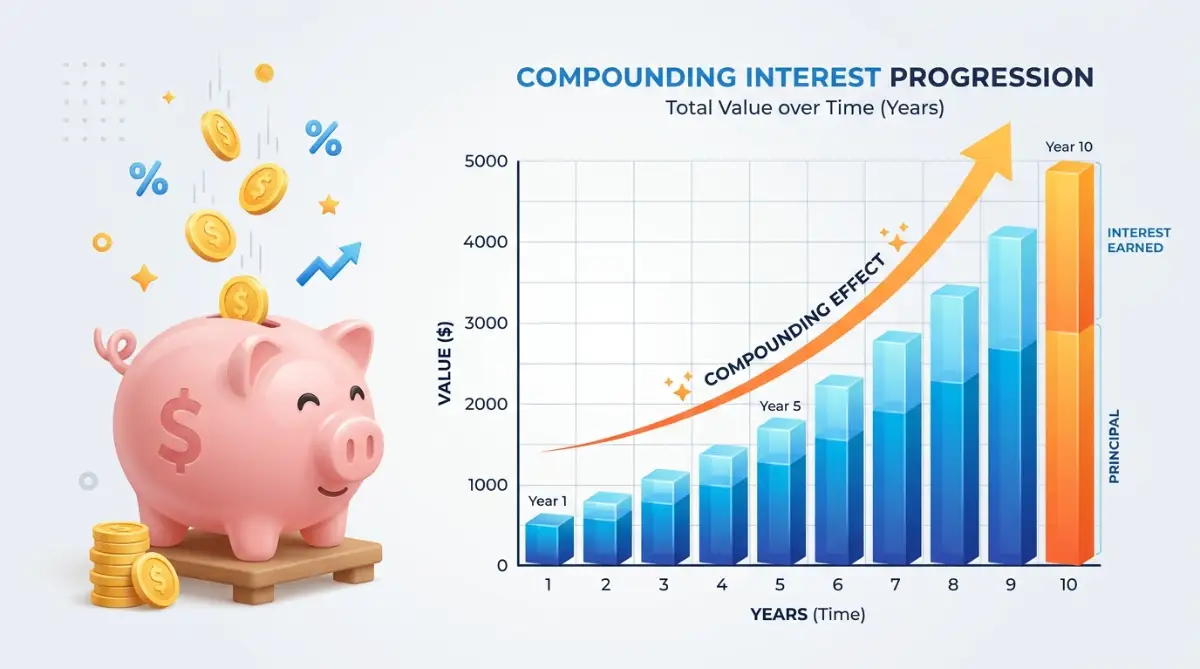
Before you look at any complex formulas, you need to understand the difference between simple interest and compound interest. Simple interest is like a straight line, while compound interest behaves like a rolling snowball.
Simple interest only calculates your cost based on the original amount you borrowed. If you borrow one hundred dollars at a ten percent annual rate, you pay ten dollars in interest every year.
Compound interest is different because it charges you interest on your interest. If you do not pay off that ten dollars in the first year, the bank will charge you ten percent on one hundred and ten dollars the next year.
To make this easy to visualize, think of a simple garden. Simple interest is like planting a single tomato plant that gives you five tomatoes every single season. It never grows larger, but it remains highly predictable. Compound interest is like taking those five tomatoes, planting their seeds, and growing five new plants the next year. Your garden grows larger and larger over time, even if you do not buy any new plants. When you are saving money, compound interest is your best friend. But when you are borrowing money, it can quickly turn into your worst enemy if you do not watch it closely. Always ask your lender if your rate is simple or compounding before you sign any paperwork. This single question will tell you exactly how your balance will behave over time.
Master the Compounding Frequency: The Secret Multiplier
Most people look at the annual interest rate and assume that is all they need to know. But the most important detail is actually how often the bank calculates that rate. This is known as the compounding frequency. A ten percent interest rate can cost you vastly different amounts depending on how often it compounds.
- Annual Compounding: The bank calculates your interest once a year.
- Monthly Compounding: The bank divides your rate by twelve and calculates it every month.
- Daily Compounding: The bank divides your rate by three hundred and sixty-five and calculates it every single day.
Let us look at a real-life scenario to see how this works. Imagine you have a ten thousand dollar loan with a ten percent interest rate. If the loan compounds annually, you will owe exactly one thousand dollars in interest at the end of the year. Your total balance becomes eleven thousand dollars. But if that same loan compounds daily, the math changes. The bank calculates a tiny amount of interest today, adds it to your balance, and then uses that new, higher balance to calculate tomorrow's interest. By the end of the year, daily compounding will cost you significantly more than annual compounding. Always look for the compounding term in your contract. It is usually buried in the middle of the document in very small print. If you can, always choose loans that compound monthly rather than daily. This small change can save you hundreds of dollars over the lifetime of your agreement.
"Want to see exactly how compounding frequencies can quietly shrink or grow your money over time? Watch this quick, easy-to-understand video breakdown before reading on to see a real-life example!"
Calculate Your Real Annual Cost: The Ultimate Truth Detector
Lenders love to advertise a low interest rate, but they often hide extra fees in the background. To protect yourself, you must learn to find the Annual Percentage Rate (APR). The interest rate is just the basic cost of the principal. The APR is the real number because it combines the interest rate with all the administrative fees and setup costs. Think of the interest rate as the price of a plane ticket. The APR is the final amount you pay after adding baggage fees, seat selection costs, and airport taxes.
To find the actual cost of your loan, use this simple three-step method:
- Step A: Ask the lender for the "Total Finance Charge" in actual dollars, not percentages.
- Step B: Divide that dollar amount by the total number of months you will be paying off the loan.
- Step C: Compare this monthly cost against your household budget to see if it actually fits.
By focusing on the total dollar cost rather than the confusing percentages, you remove all the room for tricks. If a lender boasts about a low interest rate but refuses to show you the APR, that is a massive red flag. A reputable lender will always be completely transparent about the total cost of credit. Taking the time to understand these three steps puts you in complete control of your financial journey. You no longer have to rely on guesswork or trust the bank's word. Keep your calculations simple, focus on the real numbers, and use these tools to build a highly secure financial future. You have the power to master your money, one simple calculation at a time.
Next-Level Tactics to Outsmart Complex Loan Calculations
Once you understand how interest is calculated, you can start using that knowledge to your advantage. You do not have to accept the standard payment timeline the bank hands you. With a few smart adjustments, you can take total control of your amortization schedule. Let us look at the best strategies to shorten your debt lifespan and protect your hard-earned savings.
Slash Your Debt with Principal-Only Payments
When you make a standard monthly payment on a loan, the bank divides your money into two buckets. One bucket goes toward paying off the actual money you borrowed, which is called the principal. The other bucket goes straight into the bank’s pocket to pay the interest charges. In the early stages of a loan, the bank deliberately directs most of your money toward the interest bucket. This is known as a front-loaded loan. The bank does this to ensure they collect their profit first, just in case you decide to pay the loan off early. But you can bypass this system by making principal-only payments. By sending an extra payment and specifying that it must go directly toward your principal, you shrink the base number that interest is calculated on.
- How to apply this: Whenever you have extra cash, send a separate payment to your lender.
- The golden rule: You must explicitly write "Apply to Principal Only" on your check or select that option in your online portal.
- I made the mistake of sending extra payments online without checking this box, and the bank simply counted it as an early payment for the next month. Once I caught this error, I called my lender and made them apply it directly to my principal balance instead. Always double-check your statements the next day to verify that your extra cash is actually shrinking your base debt
- The result: If you do not specify this, the bank might simply apply it to your next monthly bill, which does not stop the interest from compounding.
To see how powerful this is, imagine you are carrying a backpack full of heavy stones. Every time you make a standard payment, you are only paying the guide to carry the bag for a few minutes. But when you make a principal-only payment, you are actually throwing a heavy stone out of the backpack. The bag gets lighter instantly, and the journey becomes much easier. Even adding a small amount, like fifty dollars extra each month, can chop years off a long-term mortgage or car loan. It is one of the most effective secrets to beating the bank at their own game.
Use the Quick Rule of 72 to Forecast Your Progress
You do not need a complex financial spreadsheet to calculate how fast your money can grow or how quickly your debt can double. You can use a classic shortcut called the Rule of 72. This simple mathematical shortcut is highly accurate and can be calculated in your head in seconds. To use it, simply take the number 72 and divide it by your current interest rate. The resulting number is the exact number of years it will take for your money to double.
Let us look at a real-life scenario to see this in action:
- Scenario A: You invest ten thousand dollars in an account with a 6% interest rate. Divide 72 by 6, and you get 12. This means your money will double to twenty thousand dollars in exactly twelve years.
- Scenario B: You are carrying credit card debt at an 18% interest rate. Divide 72 by 18, and you get 4. This means if you do not make payments, your debt will double in just four years.
This simple trick completely removes the mystery from compounding numbers. It allows you to quickly evaluate if an investment is worth your time or if a debt is too dangerous to carry. Always use this quick calculation before signing up for any long-term credit lines. It gives you an instant, realistic picture of your future financial standing.
Negotiate Better Terms by Matching Competitor Offers
Many people assume that loan terms and interest rates are set in stone. The truth is that banks are businesses, and they must compete with other lenders to keep your business. Once you know your true APR and compounding terms, you can use that data as leverage. Gather three different loan estimates from local credit unions and online lenders. Bring these documents to your primary bank and ask them to match the lowest rate.
- What to say: "I want to keep my accounts with you, but your competitor is offering a lower APR with monthly compounding."
- What to look for: Ask them to waive the origination fees or lower the compounding frequency to match the other offer.
- The outcome: Hungry loan officers will often waive administrative fees just to close the deal and meet their monthly targets.
Never feel intimidated when walking into a bank office to discuss these terms. Learning the basics of loan management gives you the confidence to protect your hard-earned money. By keeping your conversations objective and focusing on the raw numbers, you instantly gain the upper hand. You will be shocked at how quickly lenders are willing to adjust their terms when they realize you understand the math.
Five Costly Blunders That Can Quietly Destroy Your Progress
Even when you are trying your best to manage your money, it is very easy to fall into hidden financial traps. Let us look at the five most common errors people make when dealing with interest formulas, and how to avoid them.
Trusting the Bank's Pre-Calculated Charts Without Verifying
Many borrowers simply look at the summary page of a loan agreement and assume the math is correct. They see a low monthly payment and sign the contract without checking the actual line items. This is a major mistake because banks often bundle expensive credit insurance and hidden administrative fees into your principal. If you do not verify the math, you will end up paying interest on these unnecessary add-ons for years. Always ask for a complete, itemized breakdown of your loan before signing. Check every single charge and ask the lender to justify any fee you do not recognize.
Ignoring the Difference Between Simple and Compound Rates
Choosing a loan with daily compound interest when a simple interest option is available can cost you thousands of extra dollars. Many people make this mistake because they only look at the base interest rate.
A 7% simple interest rate is vastly different from a 7% daily compounding rate.
Over a five-year period, the daily compounding rate will pull significantly more cash out of your pocket. Always read the fine print to confirm exactly how and when interest is added to your balance.
Falling for the Deferred Interest Trap on Store Credit Cards
Many retail stores offer special deals like "No Interest for 12 Months" on expensive electronics or furniture. Following a reliable personal finance guide will help you understand why this offer is actually a highly dangerous trap. If you do not pay off the balance completely by the very last day of the promotional period, the store will charge you retroactive interest.
This means they will calculate interest on the full original purchase price starting from day one, even if you only owe a few dollars on the final day.
- The Trap: You buy a thousand-dollar television and pay off nine hundred and ninety dollars over the year.
- The Consequence: Because you owe ten dollars on the final day, the store charges you interest on the full thousand dollars for the entire twelve months.
- The Solution: Always set your automatic payments to clear the balance at least one full month before the promotional period ends.
Relying Entirely on Online Financial Calculators
While internet calculators are convenient, they often simplify the math too much. They might assume annual compounding when your actual loan compounds daily, leading to inaccurate results. Relying on these tools can leave you with a surprise balance at the end of your loan term. Make it a habit to check the official paper statements sent by your lender each month to ensure your payments are reducing the balance as expected.
Using High-Interest Credit to Pay Off Low-Interest Debt
Some people try to consolidate their debts by taking out personal loans without checking the actual APR. They might use a new loan with a 15% APR to pay off an old debt that only had an 8% rate. They do this because the new loan offers a lower monthly payment by stretching the timeline over many years. While your monthly bill might feel easier to handle, you will end up paying far more total interest over the longer timeline. Always compare the total cost of credit, not just the monthly payment amount.
Taking Back Control of Your Financial Future Today
Stepping into the world of finance can feel overwhelming, but you do not need to be a math genius to protect your money. By understanding how interest works, you have already taken the most important step toward financial freedom. Remember that debt is not a personal failure; it is simply a mathematical puzzle that can be solved with patience and the right tools. You now have the exact strategies needed to spot hidden fees, calculate true costs, and avoid expensive marketing traps.
Start today by pulling out one of your current loan or credit card statements. Look for the compounding frequency and calculate your real cost using the tools you have learned. Taking this small action will give you the confidence to make smarter decisions and keep more of your hard-earned cash in your own pocket. You work too hard for your money to let confusing formulas steal it away from you. Do not let the fear of big numbers hold you back from managing your money. You have the power to take control of your financial destiny starting today. Pull out your oldest credit card statement tonight, look for the compounding frequency, and take your very first step toward freedom.