
The Heavy Burden of the Endless Debt Cycle
Do you ever wake up in the middle of the night with a tight feeling in your chest? That sudden, sinking realization that your credit card bill is due soon. You work hard every single month, yet your bank balance never seems to reflect your effort. I will never forget the panic I felt a few years ago when I realized my own credit card debt had somehow grown, even though I was making payments every single month.
I felt so embarrassed and trapped, quietly doing mental math at the grocery store to make sure my card would not decline. I am sharing this because I want you to know exactly what it is like to drown in these numbers, and more importantly, how I finally found my way out. Every time you make a payment, the balance barely moves. It feels like you are trying to empty the ocean with a tiny teaspoon. You are not alone in this struggle. Millions of honest, hard-working people are trapped in a system designed to keep them paying forever. The financial industry makes a massive profit off your confusion. They use complicated math to slowly drain your hard-earned money.
Let us look at exactly why so many people fail to find a real way out of this trap.
Why Good People Keep Falling for Bad Financial Advice:
- Confusing Bank Jargon: Financial institutions use complex terms like "Annual Percentage Yield" and "Daily Periodic Rate" to intentionally confuse you. When you do not understand the rules, you cannot win the game.
- The Minimum Payment Myth: Banks highlight the "minimum payment due" in bold letters on your statement. They make you believe that paying this small amount means you are doing the right thing.
- Predatory Balance Transfers: You might see offers for zero-percent interest balance transfers. However, hidden fees and sudden rate hikes turn these "lifelines" into deeper traps.
- Vague Online Advice: Most financial blogs just tell you to "spend less and save more." They completely fail to explain the real math behind how your debt is multiplying while you sleep.
The Hidden Cost on Your Mental Peace and Confidence:
- Sleepless Nights: The constant worry about money ruins your sleep quality. You lie awake doing mental math, trying to figure out how to cover the next grocery bill.
- Strained Relationships: Financial stress is a leading cause of arguments between couples. The secret shame of hiding high credit card balances creates a wall between you and your partner.
- Crushed Self-Esteem: You start to feel like a failure because you cannot seem to get ahead. You watch others buy homes or take vacations, wondering what is wrong with you.
- Decision Paralysis: The sheer amount of debt makes you feel completely stuck. You become so overwhelmed that you stop checking your mail and ignore phone calls from unknown numbers.
Living under the dark cloud of growing debt changes how you view the world. You stop making plans for your future because all your energy goes into surviving today. Your goals, dreams, and ambitions are put on an indefinite hold. The worst part is that you are probably doing everything you were taught to do. You pay your bills on time, you try to budget, and you work long hours. Yet, an invisible force keeps pulling you backward. That invisible force has a name, and it is entirely based on basic math. Once you understand the mechanics behind this force, you can finally stop it from ruining your life.

Cracking the Code: Reversing the Math That Keeps You Poor
To fix a broken engine, you first need to understand how the parts move together. The same logic applies to your personal finances. If you do not know how the bank calculates what you owe, you will always be at their mercy. We are going to break down the mechanics of your debt. We will use simple logic and practical steps that you can start using today.
Step 1: Understand the Aggressive Snowball Effect of Your Loans
We need to talk about the concept of interest. Most people think of interest as a simple, flat fee that the bank charges for borrowing money. If you borrow $100 and the interest is 10%, you pay back $110, right? Unfortunately, that is simple interest. Banks almost never use simple interest when they lend you money. They use something much more aggressive. They use a system where your interest creates its own interest. This is the core problem working against you.
The Snowball Rolling Down the Hill
Imagine you are standing at the top of a snowy mountain. You pack a small snowball in your hands and gently roll it down the hill. At first, it is just a tiny ball moving slowly. But as it rolls, it picks up more snow. The larger it gets, the faster it rolls, and the more snow it grabs. By the time it reaches the bottom, that tiny snowball is a massive, unstoppable boulder. This is exactly how your credit card balance operates. The bank does not just charge you interest on the money you spent. They charge you interest on the money you spent, plus the interest they already charged you yesterday.
The Daily Math Behind the Trap
Let us look at a realistic scenario so you can clearly see the math. Let us say you have a $5,000 balance on a credit card. Your interest rate is 24%. The bank divides that 24% by 365 days to find your daily interest rate. Every single night, at midnight, the bank adds a small charge to your account. On day one, they charge you interest on $5,000. On day two, your balance is a little higher because of yesterday's charge. Now, they charge you interest on $5,000 plus yesterday's interest. It compounds daily. Your debt is physically growing while you are sleeping, while you are eating, and while you are working.
Actionable Advice for Today: Log into your bank account right now and find your exact Annual Percentage Rate (APR). Write that number down on a sticky note and put it on your computer. You cannot fight an enemy if you do not know exactly how strong it is.
Step 2: Stop the Financial Bleeding by Changing Your Minimum Payment Habit
Now that we know how fast the snowball is rolling, we have to look at how we are fighting it. For most people, the weapon of choice is the "Minimum Payment." This is the most dangerous illusion in the entire financial industry. The bank tells you exactly how much you need to pay to keep your account in good standing. They make this number look very small and manageable. Because it feels manageable, you pay it without thinking twice. You feel a sense of relief because you met your obligation for the month.
The Illusion of Financial Progress
Let us introduce you to a guy named John. John has that same $5,000 credit card debt at a 24% interest rate. His bank statement says his minimum payment due is just $100. John happily pays the $100. He thinks, "At this rate, I will have this paid off eventually." What John does not realize is how the bank splits up his $100 payment. Almost $100 of that payment goes purely toward paying the interest that grew over the last month. Maybe $2 or $3 actually goes toward the original $5,000 he borrowed.
The Real Life Consequences of Paying the Minimum
If John keeps paying just that $100 minimum, do you know how long it will take him to clear the debt? It will take him decades. Worse than that, by the time he finishes, he will have paid the bank back roughly $15,000. He borrowed five thousand, but he paid back fifteen thousand. This is how magnificent bank towers are built in city centers. They are funded by millions of people paying the minimum amount. The minimum payment is mathematically designed to keep you in debt for as long as legally possible.
Actionable Advice for Today: You must immediately break the habit of paying the exact minimum. Even if things are incredibly tight, pay the minimum plus $10. Pay the minimum plus $20. Every single extra dollar you send goes straight to the principal balance. It bypasses the interest completely. Slashing the principal is the only way to shrink the snowball.
Step 3: Attack High-Interest Drains Using the Avalanche Method
When people decide they finally want to get out of debt, they often panic. They try to pay a little bit extra on everything at once. They send an extra $10 to their car loan, $10 to their student loan, and $10 to a credit card. While the intention is good, this is mathematically inefficient. Spreading your extra cash around dilutes your attacking power. You need a highly focused, scientific strategy to kill the interest. Financial experts and mathematicians highly recommend a strategy known as the Avalanche Method. This method is based purely on logic and numbers, ignoring emotions completely.
Treating Your Debt Like a Medical Emergency
Think of your debts like leaks in a sinking boat. You have a massive hole gushing water, a medium hole, and a tiny crack. Which one do you fix first? Obviously, you patch the massive hole that is letting in the most water. The Avalanche method applies this exact logic to your money. You need to list out all of your debts on a piece of paper. You are not going to organize them by how much you owe. You are going to organize them strictly by their interest rate.
Executing the Strategy Step by Step
Put the debt with the highest interest rate at the very top of your list. This is your massive hole. This is the account that is stealing your money the fastest. For all your other debts, you will pay exactly the minimum amount. Do not send them a single extra penny. Take every single spare dollar you can find and throw it violently at that top account. Sell old clothes online, cut out restaurant meals, or work an extra shift. Funnel all that extra cash exclusively to the highest-rate debt. Once that first account is entirely paid off, you take all the money you were throwing at it, and you move down to the next one on the list. The mathematical beauty of this strategy is undeniable. It guarantees that you pay the absolute lowest amount of overall interest to the banks.
Actionable Advice for Today: Grab a notebook right now. List your credit cards, personal loans, and car payments. Write the interest rate next to each one and draw a big red circle around the highest number. This is your new primary target.
Advanced Strategies to Beat the Banking System
Now that you understand the aggressive nature of daily interest and the power of the avalanche method, it is time to level up. You have stopped the bleeding and started attacking the main problem. However, we can speed up this process significantly. The financial system has rules that seem designed to keep you trapped, but you can actually use these same rules to your advantage. Banks constantly compete with each other for your business. We are going to use their hunger for new customers to save you thousands of dollars. Let us look at a few advanced methods that financial advisors use to help their wealthy clients restructure their liabilities.
Step 4: Shield Your Money Using a Zero-Percent Transfer
If you are fighting a massive 24% interest rate, every month feels like an uphill battle. The bank takes a huge chunk of your payment just for the privilege of holding the balance. You can legally pause this interest trap by using a balance transfer strategy. Many competing banks will offer you a promotional 0% interest period if you move your balance over to them. Think of this like moving a burning fire into a completely fireproof concrete box. The fire stops spreading immediately.
The Math Behind the Transfer Strategy
Let us imagine you have that same $5,000 balance, but you move it to a new card offering 0% interest for twelve months. The new bank might charge a small, one-time transfer fee of 3%. That fee is $150. You now owe $5,150, but the daily compounding interest completely stops. If you divide $5,150 by twelve months, your new target payment is about $429 per month. If you pay exactly that amount every single month, the debt will be entirely gone in a year.
You will not pay a single extra penny in interest. This is an incredibly powerful tool, but you must be disciplined to make it work.
Step 5: The Hidden Power of a Simple Phone Call
Most people are terrified of talking to their credit card companies. They view the bank as an unquestionable authority figure. The reality is that customer service representatives have the power to lower your interest rate directly. You just have to be brave enough to ask them. Banks spend hundreds of dollars in marketing just to acquire a single customer. They absolutely hate losing you to a competitor.
A Proven Script You Can Use Today
Call the number on the back of your card and ask to speak with the retention department. This is the team responsible for keeping customers happy. You can say something very simple: "Hi, I have been a loyal customer for a while, but I just received a zero-percent transfer offer from another bank. Before I move my balance, can you lower my current interest rate?" You will be shocked at how often this works. They might instantly drop your rate from 24% to 15%. That five-minute phone call could literally save you hundreds of dollars over the next few months. If they say no, you simply hang up, call back later, and try again with a different representative.
The Pro-Level Guideline for Permanent Wealth Building
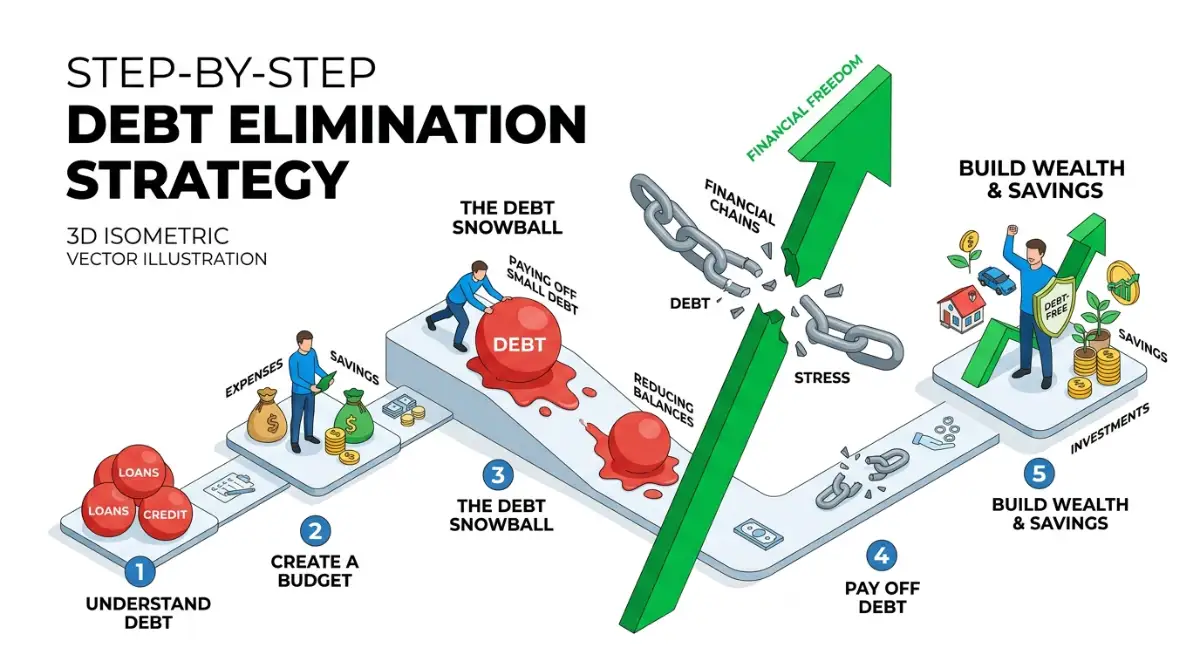
Escaping the debt cycle is an amazing feeling, but staying out of it requires a completely new mindset. You need a reliable system that works automatically in the background of your life. First, you must put all of your fixed bills on auto-pay. Late fees are completely useless expenses that you should never have to pay. Second, you need to build a defensive wall between you and the banks. This wall is your emergency cash buffer.
Start by keeping just one month of basic living expenses in a separate savings account. If your car breaks down or your roof leaks, you use this cash instead of swiping a high-interest card. Over time, you will grow this buffer to cover three to six months of expenses. Once you have this cash wall built, compound interest will actually start working for you instead of against you.
The Most Dangerous Pitfalls That Will Reset Your Progress
The journey to financial freedom is rarely a straight line. Along the way, there are hidden traps that can easily ruin your hard work. I have seen countless people make incredible progress, only to make one bad decision that sends them right back to square one. When you are tired and stressed, it is very easy to look for shortcuts. Unfortunately, in personal finance, shortcuts almost always lead to disaster. Let us carefully examine the five biggest mistakes people make when trying to escape high balances.
Mistake 1: The "Cut and Close" Panic Habit
When people finally pay off a stressful credit card, their first instinct is to cancel the account entirely. They want to cut the plastic into tiny pieces and call the bank to close it forever. This feels emotionally satisfying, but it is actually a terrible mathematical move. Your credit score is heavily based on the total amount of credit you have available versus how much you are using. When you close a card, you instantly shrink your total available credit. This makes it look like you are maxing out your remaining cards, which aggressively drops your credit score.
The Fix: Cut the physical plastic if you must, but keep the account legally open and active. Let the zero balance sit there and positively boost your credit profile.
Mistake 2: Falling for the Consolidation Illusion
You have probably seen advertisements for companies promising to magically combine all your bills into one low monthly payment. They call this debt consolidation. They pay off your credit cards and give you a shiny new personal loan. The problem is that consolidation treats the symptom, not the disease. People feel a false sense of relief because their monthly payment went down. Suddenly, they see empty credit cards and start spending on them again.
The Consequence: Within a year, they now have a massive consolidation loan plus new maxed-out credit cards. They have literally doubled their financial trouble by ignoring their spending habits.
Mistake 3: Operating Without a Basic Safety Net
Many people get so aggressive about paying down their loans that they drain their checking accounts to zero. They throw every single spare dime at the bank. While the enthusiasm is great, this leaves you completely exposed to the realities of life. Life is unpredictable and expensive. If you have zero cash in the bank, what happens when you get sick and miss a week of work? You are forced to borrow money again just to buy groceries.
The Consequence: This creates a devastating psychological blow. You feel like a failure for going back into debt, which often causes people to give up on their financial goals completely.
Mistake 4: Shuffling Balances Without Changing Behavior
We talked about balance transfers being a powerful tool, but they are incredibly dangerous if misused. Some people treat zero-percent offers like an endless game of musical chairs. They move money from Bank A to Bank B, and then to Bank C when the promotion ends. They never actually pay down the principal amount. Eventually, the music stops. They run out of good credit, get denied for a new transfer, and the interest rate suddenly spikes to 29%.
The Consequence: The bank hits them with retroactive fees and massive penalties. The snowball they were hiding suddenly crushes them overnight.
Mistake 5: Fighting the Financial Battle in Secret
Money is an incredibly taboo subject in our society. People are more comfortable talking about their medical history than their bank accounts. Because of this deep shame, people hide their financial struggles from their spouses, partners, and family members. They try to manage the stress entirely alone. This secrecy destroys relationships from the inside out. You cannot build a stable life with someone while hiding a massive, leaking hole in the floorboards.
The Fix: You must sit down at the kitchen table and have an honest, uncomfortable conversation. A team working together can pay off a balance twice as fast as a person hiding in the shadows.
Your Blueprint for Permanent Financial Freedom
We have covered a massive amount of ground today, and you should be incredibly proud of yourself for taking this step. Reading and understanding this math is the hardest part of the entire journey. You now know exactly how the financial system uses daily compounding math to keep ordinary people trapped. More importantly, you now have the exact tools required to break that cycle permanently. Remember, the bank wants you to feel overwhelmed. They want you to blindly pay the minimum amount without questioning the rules of the game.
By simply changing how you direct your payments, you take all of your power back. The avalanche method gives you a clear, logical map to follow when you feel lost. A simple phone call or a smart balance transfer can freeze the interest and give you room to breathe. You are no longer a victim of a confusing system. You are now the director of your own financial future. The road ahead will require discipline, patience, and a few sacrifices along the way. There will be months where it feels like you are barely making a dent. Do not let the temporary frustration cloud your long-term vision.
Every single dollar you pay above the minimum is a step toward complete freedom. Start today, protect your peace of mind, and watch how quickly your life changes when you no longer owe anyone a dime.