
The Sudden Jolt: Why Sleep Twitching Ruins Your Rest
I still remember the absolute panic I felt the very first time my body violently jerked me awake right as I was drifting off. I sat straight up in the dark, my heart hammering against my ribs like crazy, genuinely terrified that something was seriously wrong with my brain. For weeks, every single time I tried to close my eyes, that terrifying cliff-falling sensation would drag me right back into a state of pure, exhausting anxiety.
You are finally lying in bed after a long, exhausting day. Your eyes feel heavy, your breathing slows down, and you are just about to cross the sweet line into deep sleep. Suddenly, you feel like you are falling off a cliff. Your whole body jerks violently, your heart races, and your eyes snap wide open. This terrifying sensation completely ruins your relaxing moment. Instead of drifting off peacefully, you are now wide awake, sweating, and wondering what is wrong with your health. This sudden movement is called a hypnic jerk or a sleep start. While it is incredibly common, it leaves millions of people feeling exhausted, frustrated, and scared to close their eyes again.
Why You Can Never Find the Right Answers
When this happens night after night, the first thing we usually do is search for answers online. But the information out there can actually make your situation much worse. Instead of finding simple relief, you end up feeling completely lost. Here is why the search for a cure often leads to more pain:
- Scary Self-Diagnoses: A simple online search often suggests rare neurological diseases. This instantly turns a harmless muscle twitch into a major panic attack.
- Complicated Medical Jargon: Most medical articles use heavy scientific words. They fail to explain what is happening in plain English that ordinary people can understand.
- One-Size-Fits-All Advice: You read generic tips like "just sleep more." This completely ignores your unique daily habits, work stress, and personal lifestyle.
- Dangerous Quick Fixes: Many forums suggest unverified supplements or heavy sleeping pills. These can create terrible dependencies instead of fixing the root cause.
- Ignoring the Mind-Body Connection: Most advice only focuses on physical muscles. They completely forget how your daily stress and mental state directly trigger these sudden night jolts.
The Hidden Cost of Nighttime Twitching
Dealing with these sudden body jerks is not just about losing a few minutes of sleep. It actually creates a massive chain reaction that heavily impacts your daily life. When your body refuses to transition smoothly into sleep, the side effects bleed into your mornings and afternoons. Here is how this problem quietly destroys your mental peace and confidence:
- Bedtime Anxiety: You start linking your bed with panic. Instead of viewing your bedroom as a safe place, you feel nervous the moment your head hits the pillow.
- Daytime Brain Fog: Because your sleep cycle is interrupted right at the beginning, you wake up feeling like a zombie. Focusing on simple work tasks becomes a massive struggle.
- Irritability and Mood Swings: Lack of smooth sleep makes you highly reactive. You might find yourself snapping at your family members or coworkers over tiny issues.
- Loss of Confidence: Always feeling tired makes you doubt your own abilities. You start canceling plans and avoiding social events simply because you lack the energy to participate.
- Physical Exhaustion: Your muscles never get the chance to fully repair. This leaves your body feeling heavy, sore, and deeply drained throughout the entire day.
When you combine all these factors, the reality becomes very clear. A simple body jerk before sleep is robbing you of your energy and happiness. You spend your days running on empty, relying on endless cups of coffee just to keep your eyes open. This creates a terrible cycle. The more tired you are, the more caffeine you drink. And the more caffeine you drink, the more likely you are to experience those terrifying jolts again the next night. But you do not have to live like this forever. Understanding why your brain sends these panic signals to your muscles is the first step to claiming your rest back.
Decoding the Hypnic Jerk: Science-Backed Steps to Calm Your Nervous System
To fix this issue, we first need to understand what is happening inside your brain. Think of your body as a manual car shifting gears. When you fall asleep, your brain is trying to shift from "active mode" to "rest mode." During this transition, your muscles start to relax deeply. Sometimes, your brain misinterprets this sudden muscle relaxation as you actually physically falling. To protect you, the brain sends a rapid electrical shock to your muscles to help you catch your balance.
This causes the sudden, violent kick or jerk you experience. Luckily, by tweaking a few daily habits, you can teach your brain to trust the sleep process again. Here are the most effective, science-backed steps you can apply tonight to stop the jolts. Want to see exactly what happens inside your nervous system when a hypnic jerk strikes? Watch this quick visual breakdown below to understand how to finally calm your body down before bed!
Step 1: Manage Your Late-Night Stimulant Intake
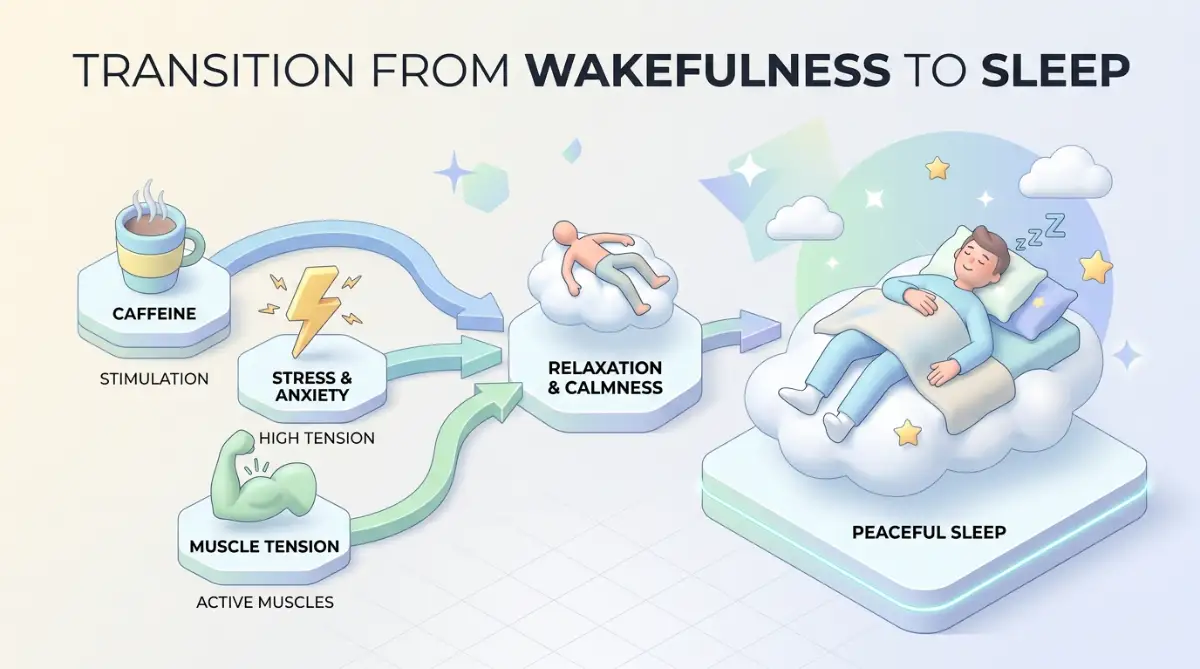
The most common reason your brain misfires during sleep is that it is simply too wired to shut down. We often consume hidden stimulants throughout the afternoon without even realizing it. Caffeine is the biggest offender here. It directly blocks the sleep-inducing chemicals in your brain, keeping your nervous system on high alert. Even if you easily fall asleep after a cup of coffee, your brain remains hyperactive. This clash between a tired body and an awake brain is the perfect recipe for a hypnic jerk.
You need to understand the half-life of caffeine. If you drink a strong coffee at 4 PM, half of that caffeine is still actively flowing through your bloodstream at 10 PM. To stop your body from twitching, you must create a strict caffeine cutoff time. Aim to stop drinking all coffee, energy drinks, and strong black teas at least eight hours before your bedtime. If you crave a warm drink in the evening, switch to herbal options. Chamomile tea, peppermint tea, or a warm glass of milk can actually soothe your nervous system. By removing stimulants, you allow your brain to smoothly shift into low gear. This tells your nervous system that it is safe to let the muscles fully relax without sending a panic signal.
Step 2: Cool Down Your Overactive Mind with a Pre-Sleep Buffer Zone
When I was going through this, my biggest mistake was staring at my phone right up until my eyes felt heavy, thinking scrolling through social media would distract me. The moment I actually forced myself to lock my phone away in a drawer one full hour before bed, the chaotic racing thoughts in my head finally started to quiet down.
If your mind is racing with thoughts about tomorrow's workload, your brain cannot transition into sleep mode. High stress keeps your cortisol levels incredibly high. Cortisol is your body's built-in alarm system. When it is active, it completely overrides melatonin, which is your natural sleep hormone. Many of us work right up until the minute we get into bed. We answer emails, scroll through intense social media debates, or watch action-packed television shows. This forces your brain to process a massive amount of information. When you suddenly turn off the lights and close your eyes, your brain is still running at a hundred miles per hour.
You need to create a dedicated pre-sleep buffer zone. This is a specific block of time dedicated entirely to cooling down your thoughts. Try applying the simple 3-2-1 rule for better sleep hygiene. Stop heavy work three hours before bed, stop eating heavy meals two hours before bed, and stop looking at all screens one hour before bed. During that final screen-free hour, engage in low-dopamine activities. Read a physical fiction book, do some light stretching, or write down your worries in a simple journal. Taking the time to dump your stressful thoughts onto a piece of paper removes them from your active memory. Your brain no longer feels the need to stay on high alert, heavily reducing the chances of a sudden muscle spasm.
Step 3: Soothe Exhausted Muscles Through Gentle Evening Habits
Sometimes, the problem is not just in your head. Heavy physical exhaustion can directly cause your muscles to twitch and spasm as they try to repair themselves. If you do intense physical labor or heavy gym workouts late in the evening, your muscles become heavily fatigued. They store up tension that releases unevenly as you drift off to sleep. Working out is amazing for overall sleep quality, but the timing matters greatly. Try to finish heavy cardiovascular or weightlifting exercises at least three to four hours before you plan to sleep.
If you often experience tight, twitchy legs at night, you might be dealing with a mild magnesium deficiency. Magnesium is a powerful mineral that acts as a natural muscle relaxer. Eating magnesium-rich foods with your dinner can make a huge difference. Include items like spinach, pumpkin seeds, almonds, or black beans in your evening meals. You can also relax your muscles physically from the outside. Taking a warm shower or bath about 90 minutes before bed is a highly effective trick. The warm water brings the blood flow to the surface of your skin, temporarily raising your body temperature. When you step out of the bath, your core body temperature rapidly drops. This rapid temperature drop mimics the natural cooling process your body goes through during deep sleep. It is a powerful biological signal that forces your muscles to loosen up and prepares your entire system for a peaceful, jerk-free night.
Step 4: Fix Your Uncomfortable Sleep Posture
Believe it or not, the way you position your body heavily influences how many sleep starts you experience. Poor posture puts intense physical stress on your nerves and joints. When a nerve gets slightly pinched or restricted, it can send a delayed electrical signal. As you fall asleep, this trapped energy suddenly releases, causing your arm or leg to kick out. Many people sleep in cramped, awkward positions. Curling up into a tight ball might feel cozy, but it restricts healthy blood flow to your extremities. You want to keep your spine as neutral and relaxed as possible. If you sleep on your back, place a soft pillow directly under your knees to take the heavy pressure off your lower back.
If you are a side sleeper, put a firm pillow between your thighs. This keeps your hips perfectly aligned and stops your leg muscles from pulling uncomfortably during the night. Also, make sure your mattress and main pillow are supporting your neck properly. If your head is tilted too far up or down, your brain might register a sense of physical imbalance. By keeping your body in a balanced, supportive position, you remove physical stress triggers. Your brain feels physically secure, which stops it from sending those terrifying "falling" signals.
Step 5: Embrace the Twitch Instead of Fighting It
This might sound a bit strange, but your mental reaction to the hypnic jerk matters just as much as the jerk itself. Anxiety is a massive fuel source for this problem. When you get jolted awake, your natural reaction is fear. Your heart beats faster, and you start worrying about whether it will happen again if you close your eyes. This fear dumps a fresh load of adrenaline right into your bloodstream. Now, your brain is actively looking for danger, making another sleep start almost guaranteed. You have to break this fear cycle. The next time you experience a sudden body jerk, remind yourself that it is completely natural.
Tell yourself, "My body is just relaxing a little too quickly. I am safe, and everything is fine." Take three slow, deep breaths. Inhale through your nose for four seconds, hold it for four seconds, and exhale slowly through your mouth for six seconds. This specific breathing pattern acts like a manual override switch for your nervous system. It forces your heart rate to slow down and clears the sudden adrenaline rush from your body. By accepting the twitch instead of fearing it, you strip away its power. You will find that you can easily roll over and fall right back to sleep within minutes.
Mastering Your Sleep Environment for a Calm Nervous System
We have already covered how your daily habits and caffeine intake affect your brain. Now, we need to look at advanced, pro-level strategies to trick your nervous system into total relaxation. Sometimes, simply cutting out coffee is not enough to stop those sudden nighttime jolts. You actually need to design a sleep environment that practically forces your brain to shut down smoothly. By applying a few specific sensory tricks, you can completely eliminate the feeling of falling. Let us explore some powerful methods that sleep experts use to calm hyperactive muscles.
Hack Your Brain's Melatonin Production With Smart Lighting
Light acts just like a master volume knob for your brain. When bright light hits your eyes, it sends a powerful daytime signal directly to your nervous system. If you stare at a bright smartphone screen right before bed, your brain literally thinks it is twelve o'clock in the afternoon. This completely stops your natural production of melatonin, the hormone responsible for smooth sleep. When you suddenly turn off your phone and plunge the room into total darkness, your brain gets confused. It has no melatonin to help it transition smoothly, which often results in a violent hypnic jerk.
To fix this, you must mimic the natural setting of the sun inside your home. About two hours before you plan to sleep, start turning off the harsh overhead lights. Switch to small, warm-toned lamps that sit lower to the ground. Using amber or red-tinted light bulbs in your bedroom can work absolute wonders for your nervous system. These warm colors do not block your melatonin production. By the time you finally close your eyes, your brain is already heavily sedated and ready for a peaceful transition.
Use Sensory Grounding to Prevent the "Falling" Sensation
The main reason you experience a sleep start is that your brain loses track of where your body is in space. As your muscles go limp, the brain panics and assumes you are falling out of a tree. You can easily prevent this panic by giving your brain continuous sensory feedback. The most effective tool for this job is a high-quality weighted blanket. A weighted blanket applies deep pressure stimulation across your entire body. It feels just like a gentle, constant hug from head to toe.
This steady physical pressure constantly reminds your brain that you are lying safely on a flat surface. Because the brain feels secure and grounded, it never triggers that terrifying falling alarm. If you do not have a weighted blanket, you can try another simple grounding trick. Try sleeping with a thick, firm pillow pressed tightly against your chest or stomach. Hugging a heavy pillow gives your arms and chest a solid object to hold onto. This provides a deep sense of physical security, relaxing your nervous system instantly.
Keep Your Bedroom Temperature Dropping
Your body operates on a very strict internal thermometer. To fall asleep and stay asleep, your core body temperature must naturally drop by a few degrees. If your bedroom is too warm, your body struggles to shed its excess heat. This internal struggle keeps your nervous system highly active and restless. A hot environment is like an overheating car engine. The brain cannot shift into rest mode, causing your muscles to twitch and spasm as they try to find comfort.
Sleep experts recommend keeping your bedroom temperature surprisingly cool. The sweet spot for most people is somewhere between 60 to 67 degrees Fahrenheit (15 to 19 degrees Celsius). You should also swap out heavy synthetic blankets for breathable cotton or linen sheets. These natural materials pull heat away from your skin, allowing your core temperature to drop naturally. When your body feels cool and comfortable, your muscles relax much deeper and much faster. This completely removes the physical tension that normally leads to nighttime jolts.
Your Long-Term Guideline for Lasting Results
Fixing your nighttime body jerks is not just a one-time project. If you want to keep these amazing results forever, you have to build absolute consistency. Your brain loves predictable routines. The best way to keep your nervous system calm is to establish an Anchor Habit. An anchor habit means waking up at the exact same time every single day, even on weekends. When your wake-up time is strictly fixed, your brain naturally learns exactly when it should start powering down at night. Give yourself at least two full weeks of following these steps before expecting perfection. Healing an overactive nervous system takes a little bit of patience. If you happen to experience a small jerk during this recovery phase, do not panic. Just stick to your calming routine, and the sudden jolts will slowly fade away for good.
The Hidden Sleep Traps Making Your Night Jolts Worse
When people try to fix their sleep issues, they often turn to popular advice that actually does more harm than good. A lot of common sleep remedies secretly damage your nervous system. If you are trying everything but still waking up with a violent twitch, you might be making a few hidden mistakes. Avoiding these specific traps is absolutely necessary for your long-term success. Here are five major mistakes you must avoid if you want to stop your body from jerking before sleep.
1. Using Alcohol as a Nighttime Sleep Aid
Many people believe that a quick glass of wine before bed helps them relax and fall asleep faster. While alcohol is a heavy depressant that might knock you out quickly, it absolutely destroys your sleep quality. As your liver processes the alcohol during the night, your body experiences a "rebound effect." Your nervous system suddenly spikes in activity to counter the alcohol. This rebound causes severe muscle twitches, heavy sweating, and sudden awakenings. If you want a smooth transition into sleep, you must avoid all alcohol at least four hours before your bedtime.
2. Eating Heavy, Spicy Meals Right Before Bed
Your digestive system requires a massive amount of energy to break down food. If you eat a large steak or a spicy pizza right before getting under the covers, your body goes into overdrive. This intense digestion process spikes your heart rate and raises your core body temperature. As we discussed earlier, a high body temperature prevents your muscles from relaxing smoothly. Instead of resting, your body is working hard to digest. This internal conflict often results in strange muscle spasms and sudden body jerks as you try to drift off.
3. Obsessing Over Smart Watches and Sleep Trackers
Wearing a fancy smartwatch to track your sleep stages might seem like a great idea. However, for many people, it creates a highly toxic condition called orthosomnia. Orthosomnia is the intense, unhealthy obsession with getting perfect sleep data. When you wake up from a small body jerk, checking your watch to see your low sleep score instantly triggers massive anxiety. This anxiety floods your body with fresh adrenaline. Instead of falling back asleep, you lie there worrying about your health data, guaranteeing another restless night.
4. Relying on Heavy Doses of Random Supplements
When desperate for rest, many people run to the pharmacy and buy heavy sleeping pills or massive doses of melatonin. This is a very dangerous game to play with your brain chemistry. Taking high doses of artificial melatonin can actually cause nightmares, grogginess, and increased muscle twitches. Your brain stops making its own natural sleep chemicals because it expects the pill to do the work. Instead of guessing with heavy supplements, focus on natural foods and gentle habits. True rest comes from a calm mind, not from a chemical dependency.
5. The "Weekend Catch-Up" Sleep Myth
After a terrible week of interrupted sleep, you might plan to sleep until noon on Saturday and Sunday. You think this will magically repay your sleep debt. Unfortunately, sleeping in ruins your carefully built circadian rhythm. It creates a condition known as "social jetlag," which totally confuses your internal body clock. By Sunday night, your brain is wide awake because you slept so late that morning. As you force yourself to sleep for work on Monday, the anxiety and physical tension guarantee the return of those sudden hypnic jerks.
Your Roadmap to Peaceful, Uninterrupted Rest
Experiencing a sudden, violent jolt right as you fall asleep is terrifying, but it does not mean your body is broken. It is simply a sign that your brain and muscles are struggling to communicate during a very delicate transition. By understanding the science behind these sleep starts, you take back your control. You no longer have to fear your own bed or worry about dangerous medical conditions. The secret to a peaceful night lies in creating a smooth, gentle runway for your nervous system to land on. From cutting late-night caffeine to using smart sensory tricks, every small change adds up to massive relief.
You now have a complete, science-backed toolkit to stop those sudden falling sensations. Try applying just one or two of these methods tonight, like dimming your lights early or enjoying a warm cup of herbal tea. Remember, healing an exhausted mind and body takes a little bit of time and gentle consistency. Be kind to yourself, trust the process, and get ready to finally enjoy the deep, uninterrupted rest you truly deserve. Trust me, if someone told me a few months ago that I would ever sleep peacefully through the night again without those sudden, jarring body kicks, I would have laughed in disbelief. By simply giving my nervous system a little bit of grace, taking things slow, and following these small daily steps, I finally got my life and my peaceful nights back.